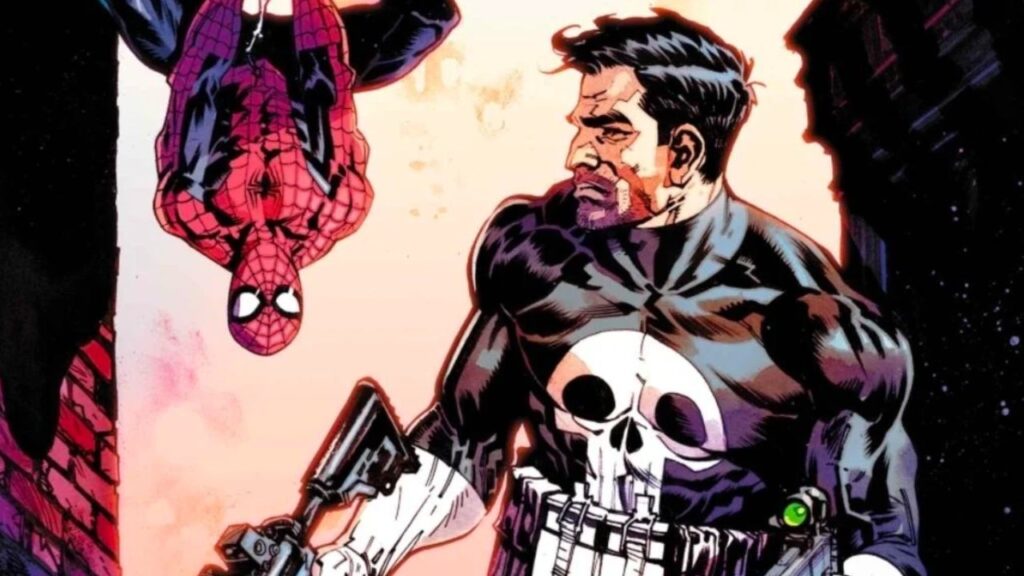
New York City is famously the birthplace of comics; it’s where the newspaper syndicates were based, where the first comic book was created and sold, and where DC, Marvel, and most of the other publishers were based for the first seven decades of the industry’s existence. It’s also where almost all superheroes live… even if they sometimes call it Metropolis or Gotham.
But the truth is that from the earliest days of comics, there was another significant location: Cleveland, Ohio. It’s where Superman is really from, and it’s also the origin point for Miles Morales, Jessica Jones, Black Lightning, American Splendor, Emmie & Friends, and many other characters, series, and creators. This is a history that’s world-famous in Cleveland, but fairly unknown everywhere else; now, however, a new 4,000-square-foot exhibition at Cleveland’s renowned Maltz Museum is dedicated to exploring and celebrating this colorful backstory.
It’s an expanded version of a traveling exhibit, JewCE: Jewish Comics Experience, which originally opened in October 2023 at the Center for Jewish History in New York and has been travelling ever since. The exhibit has been renamed Icons in Ink at the Maltz and exclusively doubled in size with a new section, “Cleveland: Home of Heroes!” It opened May 7, 2026 and runs through August 23, 2026, with a con day in July (more on that in a bit).
Full disclosure: I’m the original exhibit co-curator and new exhibit lead curator. You can read more about the original here and even watch a short documentary adaptation here.
The City of Steel
The comic book industry and its proprietary genre, superheroes, were created in the 1930s and ’40s almost entirely by first-generation American Jews, born to immigrant-refugees from Eastern Europe. Between the Great Depression and institutionalized antisemitism, they couldn’t find work, so they created an industry of their own.
New York was then home to the largest Jewish community in the world, so it only made sense for Stan Lee, Jack Kirby, Joe Simon, Bob Kane, Bill Finger, Will Eisner, Jules Feiffer, Martin Goodman, Harry Donenfeld, and so many other Golden Age pioneers to come from there. But many immigrants moved from New York to Cleveland in search of a lower cost of living and the employment opportunities of the booming industrial hub. Cleveland’s factories had earned it the nickname “City of Steel,” which would soon inspire its most famous creation: the Man of Steel.
One immigrant family that made this journey were the Siegels; another were the Shusters, who instead of New York, came to Cleveland through Toronto just across Lake Erie, where immigration laws were laxer. In 1930, 15-year-olds Jerry Siegel and Joe Shuster met in Glenville High School and became best friends. Jerry was an aspiring writer, and Joe an aspiring artist; together they created their own illustrated fanzine and comic strips. In November 1934, across one sleepless night and excited day, they came up with a new idea — Superman, the first superhero.
Cleveland celebrated this history last August when it dedicated a Superman Plaza downtown that features statues of Siegel and Shuster and a nine-and-a-half-foot Superman flying atop an eighteen-and-a-half-foot pillar. The first artifact in the Icons in Ink exhibit to welcome visitors is the original, smaller maquette for the Superman statue by famed sculptor David Deming.
Cleveland’s factories had earned it the nickname “City of Steel,” which would soon inspire its most famous creation: the Man of Steel.
The statue points to an ultra-rare copy of Famous Funnies #1 (July 1934), widely recognized as the first comic book. What can be considered the first comic art is an evolutionary question, spanning cave wall paintings to illuminated manuscripts and illustrated pulps. But the invention of comic books as a medium is credited to M.C. Gaines, an unemployed teacher and novelty salesman from the Bronx who thought to license old comic strips from the newspaper syndicates and republish them in magazine form.
Possibly together with friend Harry Wildenberg, a sales manager at Eastern Color Printing, Gaines also conceived of folding the tabloid sheets in quarters to create smaller, more economical book-size pamphlets. The result was Funnies on Parade, published May 1933, a reprint collection of strips produced by Eastern as a promotional giveaway for Procter & Gamble. Gaines then followed with the idea of selling comics on newsstands, testing the waters with Famous Funnies; it proved a smash hit, giving rise to an entire industry.
A Hero Comes Home
Siegel and Shuster famously spent four years unsuccessfully pitching their spaceman-in-spandex idea to every newspaper syndicate in the country, but it wasn’t until there was a comic book industry — and a publisher known today as DC was behind deadline and desperate for content — that Superman debuted, practically by accident, in June 1938’s Action Comics #1. Sales made Superman an instant success; while a few top-selling comics reached 200,000 copies back then, Superman sold 1.3 million. By 1941, his three titles had a combined readership of 12 million, plus a newspaper strip in 285 papers that was read by 25 million.
He became the first superhero to transition into other media with the immensely popular radio show, The Adventures of Superman. To promote it, DC’s co-owner, Harry Donenfeld, commissioned a life-size oil painting in 1940 to use in ads as well as display in his office. It hung there until 1957, when it mysteriously disappeared. Now one of the Maltz exhibit’s centerpieces, the portrait — originally painted by Hugh J. Ward with later reworking by Joseph Szokoli and possibly Stanley Kaye — became famous over the decades, gaining almost legendary status among fans and historians, having appeared in the background of several press articles but thought lost to history.
It wasn’t until 2010 that it was found at New York’s Lehman College, having been donated by Donenfeld’s wife upon his death in 1965. Apparently, Donenfeld took it with him when he retired to put up in his townhouse. Lehman officials, either unaware or dismissive of its provenance, hung it in the back of the library, where it was forgotten; Icons in Ink marks the second time it’s ever been displayed publicly.
In front of the painting, at the center of the exhibit space, is Jerry Siegel’s writing desk where he wrote almost every Superman story since 1940, as well as the Spectre, Slam Bradley, Star-Spangled Kid, Robotman, and other characters. It was donated to the Cleveland Public Library in 2017 by Jerry’s daughter, Laura, and is on special loan to the museum. It’s a remarkable piece of history to have amidst all the Golden Age comics and Joe Shuster art.
Cleveland Splendor
Superman and his creators are undeniably the stars of this show — it’s the most significant Superman exhibition since the Smithsonian’s in 1987 — but with over 100 physical objects, including rare comic books, original art, and historical artifacts, Icons in Ink is also the biggest comics exhibit in Cleveland history. And if there’s one comics creator that’s associated with Cleveland as much as Siegel and Shuster, it’s Harvey Pekar.
If Clark Kent is Superman, Harvey Pekar is Everyman; while Superman was introduced with the bombastic “Look, up in the sky,” Pekar’s comics used the tagline, “From off the streets of Cleveland comes…” Pekar was a pioneer of autobiographical comix (as “underground” comics are sometimes called), self-publishing his annual American Splendor series from 1976 to 2008, with 39 issues total. Composed of short vignettes drawn by a variety of esteemed artists (most famously Robert Crumb), and taking place primarily in Cleveland, the curmudgeonly, cynical, and disheveled Pekar wrote with a voice that was brutally honest and often hilarious. His grayishness was so extreme, it was colorful.
By 1993, American Splendor achieved a large enough following to be picked up by Dark Horse Comics, which distributed it until 2002, at which point DC’s Vertigo imprint published it until 2008. Pekar became a minor celebrity outside comics as well, becoming a recurring guest on NBC’s Late Night with David Letterman between 1986 and 1988, until a characteristic on-air tirade against NBC’s ownership by General Electric led to Pekar being banned from appearing further. In 2003, an American Splendor movie adaptation starring Paul Giamatti won the Oscar for Best Adapted Screenplay.
The exhibit features original artwork from Pekar’s comics by Crumb, Gary Dumm, and Peter Kuper. Bringing things full circle is the two-page “What Superman Means to Me” from Snarf #12 (June 1989), in which he complains about Superman and the rest of the superhero genre monopolizing the medium of comics.
Bendisworld
One of the biggest names in comics today, Brian Michael Bendis was born and raised in Cleveland, and studied at the prestigious Cleveland Institute of Art. He worked at a comic book store in the downtown Arcade — where the flying kiss in last year’s Superman was filmed, with Cleveland playing Metropolis in the movie — and cut his teeth as a staff illustrator at Cleveland’s Plain Dealer. Bendis broke into comics with two creator-owned series set in Cleveland: Jinx from Caliber Comics in 1996, which he both wrote and drew; and Torso from Image Comics in 1998, which he wrote, with art by Marc Andreyko. That landed him the gig of writing Ultimate Spider-Man with artist Mark Bagley in 2000, which turned him into an industry superstar; he and Bagley went on to break Marvel’s record for the longest consecutive run by a creative team with 111 issues.
Among his many accomplishments since, Bendis created two mega-popular characters — Jessica Jones and Miles Morales. Both have become mainstays in Marvel movies, TV shows, animation, and video games. Bendis also became a founding member of the Marvel Creative Committee, helping steer the MCU through its first 15 movies. By 2018, Bendis had reached the pinnacle of his profession, but a visit to a Superman exhibition at the Cleveland Public Library inspired him to take a chance on something new, and he moved to DC to become the primary writer of Superman. Since 2022, he’s been co-producing his own Jinxworld line of comics at Dark Horse, though last year he also returned to writing for Marvel.
The exhibit includes original art from Bendis and a rogues’ gallery of his collaborators, including Mark Bagley, Joe Quesada, Bill Sienkiewicz, Mike Deodato Jr., Art Thibert, Michael Avon Oeming, Michael Gaydos, David Marquez, Marc Andreyko, and others, making the exhibit a trip through modern age comics history as well.
Mad Man
Peter Kuper is probably known to younger fans as the writer and illustrator of MAD Magazine’s “Spy vs. Spy” strip, which he took over from creator Antonio Prohías in 1997 and has been producing since, but he’s also an internationally renowned graphic novelist and cartoonist whose work appears regularly in The New Yorker, The Nation, and Charlie Hebdo. He’s currently nominated for the 2026 Eisner Awards Hall of Fame, and was this year’s finalist for the Pulitzer Prize for his political cartoons.
Kuper’s “highbrow” comics explore social, psychological, and historical themes, usually through his signature bold, high-contrast style and use of mixed media, including stencils, spray paints, and woodcut-like techniques. He grew up in Cleveland, and the city features heavily in many of his short stories as well as in his 2007 autobiographical graphic novel, Stop Forgetting to Remember.
The exhibit features Kuper’s art from throughout his career, from his humor work in MAD to his autobio shorts to his recent entomology book, Insectopolis, showcasing just how rich and diverse the artform can be.
The Art of Growing Up
Another featured Clevelander is Terri Libenson, who’s known for her nationally syndicated comic strip, The Pajama Diaries (2006-2020), and middle-grade graphic novel series Emmie & Friends, which has sold more than 2.3 million copies worldwide and is about to release its tenth book.
Libenson started out as a writer and illustrator for the Cleveland-based American Greetings — the world’s second largest greeting card producer after Hallmark — where she learned the art of humor, relatability, and concise visual storytelling. Both her comic strips and graphic novels are slice-of-life stories often based on her own experiences concerning family, childhood, adolescence, and parenting, which have become known for capturing the delicate balance of humor and poignancy. Libenson primarily works digitally, and so her section of the exhibit mostly includes prints from her different comics, tracing her evolution as an artist and storyteller.
“Cleveland has always punched way above its weight creatively. There’s a restless energy here,” Dr. Samantha Baskind, the exhibit’s consulting curator and a Distinguished Professor of Art History at Cleveland State University, told IGN. “Cleveland is part working-class grit and part cultural powerhouse that makes the city feel like its own kind of mini–New York. Comics aren’t a footnote in Cleveland; they’re woven into the city’s identity.”
“Comics aren’t a footnote in Cleveland; they’re woven into the city’s identity.”
Dr. Miriam Eve Mora, the original exhibit’s lead curator and a historian of American immigration and ethnic history, adds that “so many comics based in NYC, that city of immigrants, are about experiencing difference, about coming to terms with being outsiders in a hard city. But in Cleveland, the children of immigrants who made comics had a different perspective. Whatever conclusions we might draw about the abundance of Cleveland comics talent (whether about the community, the geography, or if there’s something in the water), the expanded exhibit is a wonderful opportunity to highlight the extraordinary works that have emerged from the streets of Cleveland to shape comics, and from there pop culture as a whole.”
At the end of the exhibit is an all-ages play space, because any exhibition about comics that isn’t fun is missing the point. It includes a cosplay corner, replete with camera stands and giant comic book covers for backgrounds, a comic book creation station, reading library, and even an old-timey real phone booth… in case visitors need to change in a hurry.
On July 11–12, the Maltz Museum will also host “Icons Fest,” a con-like celebration of all things comics and pop culture with panels, screenings, family workshops, vendors, and a large artist alley filled with local up-and-coming creators as well as heavyweights like Brian Michael Bendis, Terri Libenson, Peter Kuper, Jon Bogdanove, Joe Rubinstein, Stan Mack, Danny Fingeroth, Jenny Isabella, Jordan Gorfinkel, Gary Dumm, Ken Krimstein, Alisa Kwitney, and many others, as well as the Siegel, Shuster, and Pekar families.
Cleveland may appear like a mild-mannered midwestern town, but don’t let that fool you: When it comes to comics, its impact is Super-sized.
Roy Schwartz is a pop culture historian and author. He is the co-curator of the JewCE: Jewish Comics Experience exhibit and lead curator of Cleveland: Home of Heroes! He also led the recent Jack Kirby Way street naming in NYC. Follow him on Instagram, Facebook, and X @RealRoySchwartz and at royschwartz.com.