
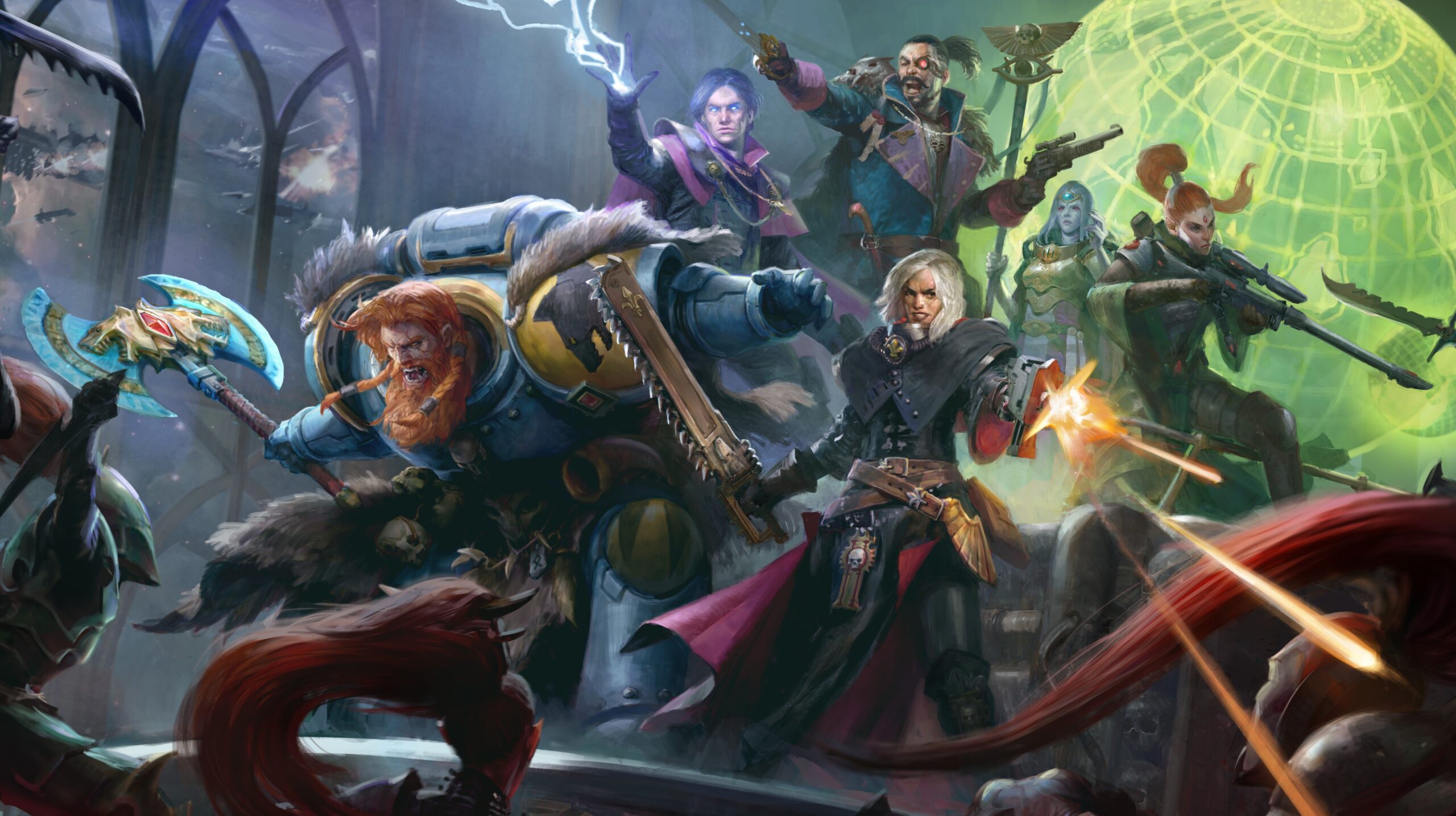
Owlcat began life as a small developer, as so many do, but with plenty of expertise on the team. 2018's Pathfinder: Kingmaker, its first game, was successful, so the natural thing to do next was to make a bigger and better sequel. Pathfinder: Wrath of the Righteous followed in 2021. Another Pathfinder might have followed, but Owlcat took a significant step forward with 2023’s Warhammer 40,000: Rogue Trader, a sort of Baldur’s Gate 3 set in the Warhammer 40,000 universe game, rougher around the edges than Larian’s masterpiece, but no less meaty and with just as good writing. It’s a fantastic role-playing game, with plenty of choice and consequence. Many feel it’s one of the best Warhammer 40,000 video games ever made. It might even be the best.
Now, Owlcat has two announced games in production: Warhammer 40,000: Dark Heresy and The Expanse: Osiris Reborn. Dark Heresy continues Owlcat's impressive run of cRPGs, but The Expanse is something of a departure for the studio, a third-person action RPG made in the Mass Effect style. And so, what started as 15 people working together on Pathfinder is now a whopping 600-person development studio making multiple big projects. Owlcat has grown enormously in just a decade, and with that growth has come significant change to the way it develops games. But, co-founder and creative director Alexander Mishulin tells me, the studio has lost none of its passion for making RPGs that pack a real punch.
I’m a huge Warhammer 40,000 fan, as anyone who’s followed my articles on IGN over the last few years will probably know. For me, Rogue Trader put Owlcat on the map, and I assume opened doors for the company. Mishulin admits Rogue Trader was an important milestone, but he points to Pathfinder: Wrath of the Righteous as the real inflection point.
“It's a huge game with a lot of different choices and, even now, it comes up in a lot of top 10 games you don’t know about but you don’t want to miss,” Mishulin says. “We couldn’t make it without Kingmaker because it was our foundation to make a second game. But also, it showed a lot of people that we were serious about making great RPGs. When a studio does a second game and it is still successful, it is proof you can make these experiences over and over with new things, new ambition, new goals. It helped start a lot of discussions with different parties about what we can do next. And of course it helped establish a good relationship with Games Workshop while doing Rogue Trader.”
Owlcat pitched Rogue Trader before Wrath of the Righteous was even released, showing Games Workshop internal versions of Pathfinder to prove it was serious about making a great isometric RPG for Warhammer 40,000 fans. But yes, after Rogue Trader came out and was a success, more doors opened for discussions, both with publishers and IP holders about what the studio might do next.
Similarly, The Expanse was discussed while Rogue Trader was in the works — Owlcat showed The Expanse rights holder Alcon Entertainment first concepts during preliminary discussions during the final stages of Rogue Trader’s development. The Expanse, with its over the shoulder camera perspective and cinematic, action RPG gameplay, is clearly a departure for Owlcat, whose previous games had a top down isometric camera perspective and deep RPG mechanics. Dark Heresy follows the cRPG trend, although the twist here is there is a focus on an investigation system and the fantasy of being an Inquisitor (Warhammer 40,000’s Imperial detectives). Owlcat has other projects in the works, and these are different again (Mishulin won’t say what they are, as you’d expect).
What is success for Owlcat? The studio has three plans for its games before they come out. One, a plan for the minimal estimation of sales and revenue. Two, a plan for the average estimation, or what the game is supposed to achieve. And three, a plan for if a game sells very, very well, like in unexpected, viral hit terms. Rogue Trader performed “better than average,” Mishulin says, more successful, certainly, than Wrath of the Righteous, and more visible, but it wasn't a viral hit in the way Baldur's Gate 3 was.
Rogue Trader's success was, first and foremost, the result of it being a great game. But the comparison to Baldur’s Gate 3 (both games came out in the same year) actually helped Rogue Trader out, too — something Mishulin is very grateful for.
“We were really humbled that a lot of players and a lot of streamers compared us to BG3,” he says, “because BG3 is an enormous behemoth. It is one of the greatest RPGs ever made with a lot of ambition, passion, everything. We hope that at some point we will be able to compete directly, but not at the time of Rogue Trader. It is not like a real competition.
“On the other hand, BG3 did a great favor to a lot of RPG games. It brought them into the spotlight. Now RPGs can be a mainstream experience. When so many players enjoyed BG3, they started to look for what our next game will be, and we enjoyed this experience. ‘What can we try?’ Some of them go to our games to try them and enjoy them. So we are really grateful to Larian that they made such a great game not only because we enjoyed it — like, most of our developers played it for hundreds of hours — but also because they really made a lot of players aware of the genres and of the great games that are present there. Not only ours, but all of the games that are in there.”
Warhammer 40,000 as a setting, as a franchise, as a tabletop game, has never been bigger. I’ve spoken to plenty of video game developers who have told me now is the time to make a Warhammer 40,000 game, with huge interest in the IP. Saber Interactive’s Space Marine 2 took Warhammer 40,000 video games to a whole new level (its protagonist, Titus, is now one of the most prominent characters in the ongoing tabletop narrative). And assuming Henry Cavill’s Warhammer 40,000 Cinematic Universe actually gets off the ground, the franchise will only grow further.
Mishulin acknowledges that Owlcat has benefited from the enormous Warhammer 40,000 audience that found the fun in Rogue Trader. But he then flips this idea on its head, insisting Rogue Trader also brought people into the Warhammer 40,000 universe. “It probably will be a little bit arrogant, but I will still say it: I hope that our efforts also brought a little bit of this golden era for Games Workshop as well,” he quips.
Owlcat saw that a percentage of Rogue Traders players who initially arrived simply to enjoy an RPG game, then became immersed in the world of Warhammer 40,000 and started to look at the tabletop experience or other video games in the setting. That is, they became fans of the Warhammer 40,000 setting through Rogue Trader.
This checks out, at least for me. My love affair with Warhammer 40,000 truly began with the first Dawn of War game, back in 2004. I had dabbled in buying minis and painting them at school beforehand, but fell out of Warhammer 40,000 until some years later. Dawn of War then got me hooked. And now, I fuss over every single lore entry from the latest codex releases and novels, even snippets of information in official online posts and, of course, the many Warhammer 40,000 video games.
Warhammer 40,000 and The Expanse — talk about two franchises with passionate fanbases! I know from experience that covering these two universes comes with extra risk, so I make extra effort to try to get the little details right. No, that’s not that chapter of Space Marines, it’s another. No, that’s not how space travel actually works in The Expanse, it works like this. This is, ultimately, a good thing! This level of detail in both universes is part of the reason fans — and I include myself in this — love them. Everything is everywhere in the right place, and the more you know, the deeper it goes.
The Expanse is a great one for this, because where Warhammer 40,000 is basically about space magic, The Expanse is basically about space science. How might things actually work if we were mining an asteroid? What impact would it have on human physiology? How might humans cope with space travel? And what would zero gravity movement look like if you were having a firefight outside the safety of your ship?
So, now, Owlcat must fuss about the small details with The Expanse, just as it does with Warhammer 40,000. But at the end of the day, they’re making a video game that must be playable and fun. “In The Expanse, we do know that sound doesn’t propagate through a vacuum, but it is not helping the gameplay," Mishulin says. "So we came up with a solution, and we discussed it internally and then with Alcon, that some waves of the sound go inside the metal of the hull and we can pick it up through the magnetic boots. So, sound is muffled, but it is there, and there is a scientific explanation for that.
“It is a stretch, but it could be explained this way. Our tech right now doesn't support it. Our tech in 300 years? We don't know. Right now our tech goes in just exponential jumps, so probably.”
Owlcat worked with a physics consultant to make sure the science fiction of its The Expanse game was plausible. One example had to do with how blood works in zero-g — Owlcat worked with the consultant to get advice on how to depict it in the game. The developers also worked with the same people who worked on The Expanse show to make sure the Belter language (Belter Creole) sounds authentic in the game.
I imagine it would have been safer for Owlcat to stick with the engine it knows and the cRPG genre it knows, rather than try something so different on Unreal Engine 5. The Expanse is a big risk for the studio, Mishulin admits. But he insists it’s also a great opportunity — and it’s lucky enough to be in the financial position to be able to take that risk.
“While isometric games are great and we enjoy them very much, we also want to try to make a more cinematic story, and try our hand at a cinematic RPG experience closer to Mass Effect,” he explains. “Some of the developers at the studio are big fans of such storytelling. When we started Owlcat, a lot of us wanted to make the games we were playing at school and university. Baldur’s Gate was a formative experience for us. But for the next generation of game developers, Mass Effect was this formative experience. It was the game that brought them into the industry. And they really wanted to do another game like that.
“We don’t want to just sit and remake what we are great at. We want to be fresh and new every time, and for that we have to take risks.”
It’s been some first decade for Owlcat, but what might the next decade have in store? The video game industry is in turmoil, nothing is certain, and what’s in vogue one minute is a laughing stock the next. Owlcat will continue to make RPGs, of course. I hope Dark Heresy is enough of a success (and great!) that it gets to make even more Warhammer 40,000 games. I hope The Expanse scratches that Mass Effect itch I’ve had ever since the controversial ending of Mass Effect 3. As for what’s next after all that? All Mishulin will say is Owlcat will continue to experiment within the RPG genre, so I have no idea really.
As an example — and this isn’t something in production right now — if someone in the studio has a great idea for a grand strategy RPG game like Crusader Kings, Owlcat would consider it, even though it’s never made one before. I do wonder if Owlcat might be the answer to the big Baldur’s Gate 4 problem, which I’ve reported on before. How do you follow Larian? Some believe Owlcat is one of the few developers around that has a chance. This is something I went in-depth on with Mishulin, and it’s fair to say I enjoyed his response.
For now, it’s all about Warhammer 40,000: Dark Heresy and The Expanse, and that is plenty to be getting on with. Speaking of The Expanse, we’ve got the exclusive on how the game’s progression system works, alongside brand new screenshots.
Wesley is Director, News at IGN. Find him on Twitter at @wyp100. You can reach Wesley at wesley_yinpoole@ign.com or confidentially at wyp100@proton.me.
