
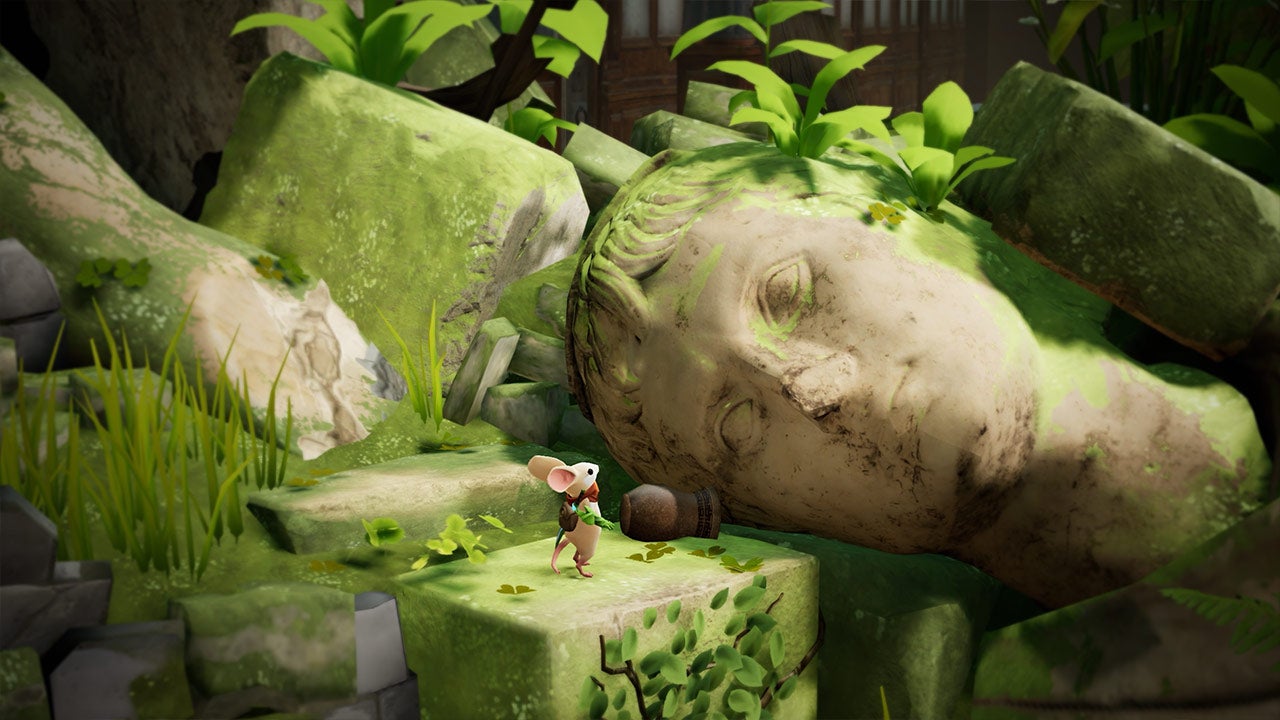
It’s rare for a game to directly acknowledge you as a player – normally, we exist in a mutually agreed upon suspension of disbelief with its characters. We are asked to inhabit them, and put ourselves aside. Moss: The Forgotten Relic, a remake of the previously VR-exclusive Moss and Moss: Book 2, discards that notion. You may control its heroine Quill, but you do not become her; you are the Reader, and the distance between you is intentional. It is also what makes Moss remarkable.
The Forgotten Relic’s story starts simply – you are in an old library and pick up a book titled Moss. Inside, you meet Quill, a young mouse who dreams of adventure and finds it thanks to a piece of Glass, an artifact of great power and long history. Holding it means she can interact with you, the Reader, and you can change the story. From that moment, her fate and yours intertwine, but when she shows the Glass to her uncle – and he realizes what your bond means – he warns Quill that she is in danger and leaves to take care of something else. When he doesn’t return, Quill follows at the behest of a Starthing – mischievous beings who meddle in the lives of mortal animals – who claims to know where he is. She knows her uncle needs her help. And you go with her.
Moss’s story is a fairy tale, and like all fairy tales, it grows with the telling. What starts simple rarely remains that way, and Quill’s quest strays far from its initial objectives. It is not a deep story; it will not make you re-evaluate your life or question your beliefs. But Moss commits so thoroughly to its premise and is so charming in its execution that it won me over completely. When you transition to a new screen, you can hear a page turning. A narrator reads prose and provides different voices for each character. Many dramatic moments are beautifully rendered on the book's pages, and you flip them yourself to advance the story. Plenty of stories proclaim to be inspired by fairy tales; Moss is one. You can almost hear the narrator wanting to tell you that nothing bad happens to Quill during scary moments.
There are plenty of memorable characters in Moss (I love the grumpy toad you often encounter), but Quill is this tale's beating heart; without her, there is no story, nothing to care for. She is brave, but not fearless; resolved, but aware that she cannot do what needs to be done alone; strong, but not stoic. I felt for her when she was sad or afraid, but she was not simply someone in need of my protection. We were a team. If I was stuck, Quill would point the way and show me what to do. If I accidentally piloted her off a cliff or into a pond, she'd re-enter the area and shake herself off, ready to try again. And when we triumphed, she would high five me or sometimes break into elaborate dance. Her joy is infectious, and I wanted her to succeed not because I wanted to keep playing, but because I liked her. It’s hard for a game to make you feel truly connected to a character, but Moss succeeds.
The game side of Moss is also simple enough, especially the first half of this two-part compilation. While you can see its VR origins in the small environments and your ability to interact directly with parts of the world, developer PolyArc has done an admirable job of turning this duology into traditional games. Had I not known that they started life as VR exclusives, I probably wouldn't have been able to tell. Occasionally, it can be hard to see whether you can interact with something, or you might deal with the odd awkward camera angle, but these are pretty minor qualms and I never met anything I couldn’t handle. I did have a weird softlock once when I opened a door before I was supposed to, but a quick restart fixed that, and Moss is generous with its checkpoints.
The action itself is smooth and straightforward. You can make Quill run, jump, climb, and dodge, and she is armed with a single sword to defend herself. As the Reader, you can hold the mechanical beetles she fights in place so they can't attack her or move objects to create paths and platforms for her to jump to. These are simple actions individually, but it’s when Moss combines combat and platforming, and requires you to control Quill and the Reader in harmony, that it triumphs. The best puzzles require you to pilot Quill while manipulating the environment and enemies to get where you need to go, and figuring out what you need to do (and finding collectible scrolls and dust along the way) is a joy. Maybe that will require you (the Reader) to use a bug to flip a switch so Quill can get to a new area, or simply activate a series of switches in the right order so you can use the environmental changes they cause to make a new path. Simple stuff, yes, but compelling.
Book 2 takes everything Moss did right and expands upon it. In addition to introducing more characters (one of which is playable) and a larger scope, this sequel adds additional weapons: a chakram (the key to understanding modern media is that everything is, in some way, indebted to Xena: Warrior Princess) and a hammer. The sword now has a dash that allows Quill to fly across gaps, the chakram can be embedded into walls and then called back to smite enemies or solve puzzles, and the hammer is, well… a hammer. There are even new enemies, like little metal pill bugs that you can send flying to open new pathways and smash other evil insects.
But probably the biggest change is Quill’s ability to climb vines. With that, the broken stone and overgrown ruins of Moss become more challenging and interesting to move across, which adds to the idea that this is a living world. As the Reader, you augment this with a power that can grow vines and verdant pathways, opening up new ways for Quill to travel and increasing the complexity of the world and its puzzles.
Don’t get me wrong: I think the original game is worth playing, though you don’t have to. There’s a nice little summary when you start Book 2. It’s a simpler game, but it’s incredibly charming and has some great moments that a recap just doesn’t do justice.
None of what either Moss asks of you is particularly difficult, but when everything is thrown together, it is compelling. I enjoyed solving its puzzles (especially when it took multiple steps and I had to combine all my skills), hunting for secrets, and generally just spending time with Quill and exploring Moss’s world. The Forgotten Relic invites you to live in this book, both a part of its story and separate from it, and I liked that. Moss doesn’t just throw lore at you; it tells its story and expects you to follow along. You won’t know, exactly, what a Reader is or why Glass is powerful or what the Cinder Night was from the jump, but if you pay attention, Moss will teach you, and things are more nuanced than they originally appear. There’s no codex to check and while exposition does happen, it’s generally because both you and Quill are ignorant of something and need to learn.
