
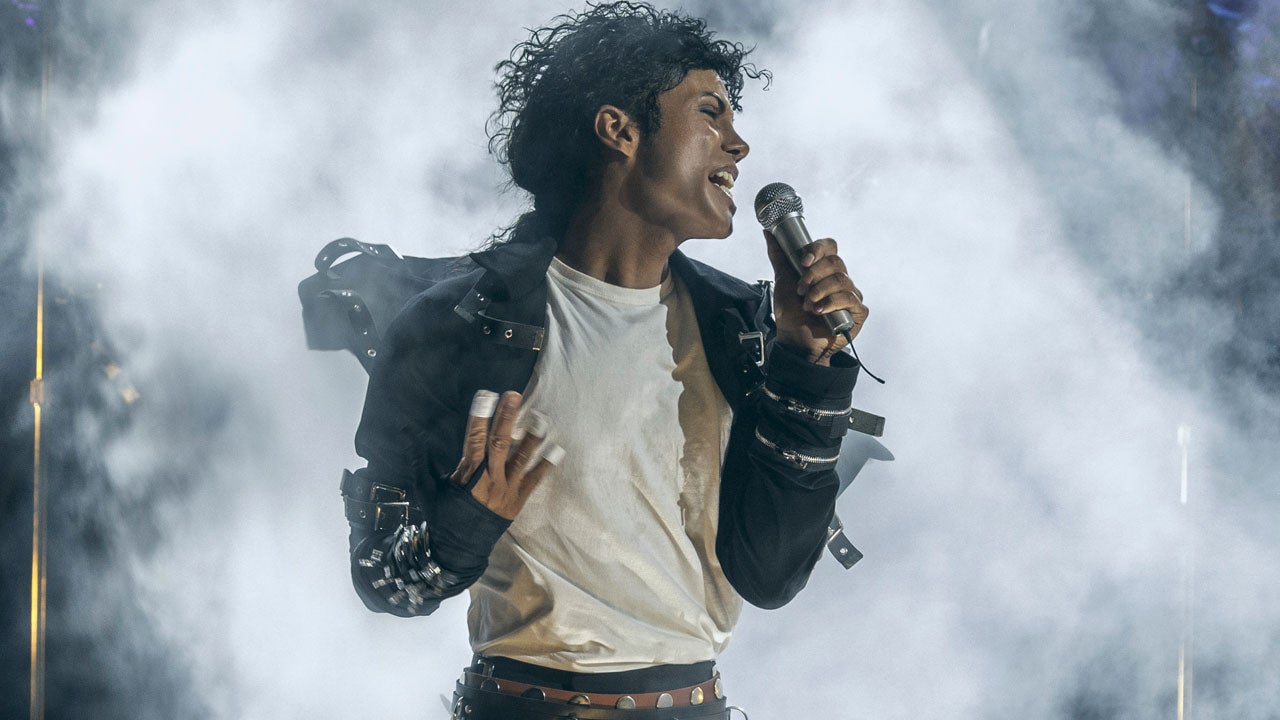
Michael hits theaters on April 24.
At this point in Hollywood history, one must succumb to the notion that the pop-star-as-IP movie isn’t going to change. Walk Hard lampooned it nearly 20 years ago (“Dewey Cox has to think about his entire life before he plays!”) but the music biopic limped on at its most formulaic, culminating with the near-billion dollar success of Bohemian Rhapsody. Sometimes, people just want their favorite artists to play the hits, and who can blame them? With the rote parameters of this jukebox filmmaking set in stone, one can only hope that someone will come along and shake things up from within; after all, a built-in audience is guaranteed, so you may as well give it the old college try. Unfortunately, Michael is not that movie, and Antoine Fuqua is not that filmmaker, which should come as no surprise. However, it’s astonishing to note just how short the movie falls of the genre’s already low expectations. In fact, it does the one thing no production should be able to. It makes Michael Jackson — the King of Pop and one of the most controversial, electric, groundbreaking figures of the 20th century — utterly boring.
Jackson needs no introduction, but a hypothetical viewer who’s never heard of him might come away from Michael wondering what all the fuss was about. Granted, this result is partially circumstantial, since much of the film had to be rewritten and reshot when the pop star’s estate realized that, thanks to a settlement with one of Jackson’s accusers, the allegations of child molestation and subsequent court cases couldn’t be featured. These were once the dramatic heart of the movie, and the central framing device, which — no matter how flattering or didactic they might have been, thanks to the Jackson family’s stewardship — sound like much more compelling drama than what ends up on screen.
Michael, as it exists in its current, largely incomplete form, is a frictionless, flat, paper-thin story that’s so concerned with fidelity to bullet points and recognizable highlights that it robs its characters of soul — not to mention the actors playing them. After opening at some undetermined point in the 1980s, where we only get a glimpse of Jackson’s shoes, the story begins in earnest in the ’60s with the formation of the Jackson 5, the Motown band of brothers led by an adolescent Jackson (Juliano Krue Valdi) and managed by his domineering father, Joe (Colman Domingo). It sounds simple enough, but this is where the movie’s problems noticeably begin. In an effort to make Domingo look exactly like the family patriarch, the actor is saddled with awkward, limiting prosthetics that both inhibit his performance, and give him the exaggerated appearance of a Dick Tracy villain — or worse yet, his son’s zombified appearance in the music video for “Thriller.” It’s rigid and incredibly distracting.
Valdi, thankfully, provides a semblance of heart as a young, innocent Jackson living in his father’s shadow, but you can practically set your watch to each time a new year is noted on screen in an art deco type face, followed by a five-minute performance of one of the group’s early hits — and then another, and another, and another. These early scenes also set a trend for how the other members of Jackson’s family are portrayed. While sister Janet is absent from the film (of her own volition), Jackson’s four brothers and bandmates are at best window dressing throughout the entire runtime, while Jackson himself is the only one who appears to have any kind of relationship or interaction with their father. Michael may be the story of someone being launched into global stardom, but the world outside Jackson’s window seldom seems to exist — the very same world that would embrace and reject him, adore and abhor him, and which would inspire some of his more sentimental tracks.
That Michael is such a small and contained film is undoubtedly strange, but it’s by no means a death-knell. After all, in lieu of the accusations storyline, the dynamic between Jackson and his father ends up relatively central once the star enters young adulthood, where he’s played by real-life nephew Jaafar Jackson. But gosh, is it ever hard to squeeze meaningful drama from these leftover pieces. The scant father-and-son interactions become outstretched and silently repetitive. The plot, as expected, becomes mechanically focused on what song Jackson produced at which point in time. During this predictable unspooling, actor KeiLyn Durrel Jones gets a mournful close-up or two as the icon’s long-suffering bodyguard Bill Bray, who observes his employer’s isolation, but he never gets to do much beyond that, despite being the film’s second or third most prevalent character by default. Love Jackson or hate him, his oddities and idiosyncrasies were a matter of public record. But rather than engaging with his arrested development as something psychologically complex, the movie presents him as a bog-standard, misunderstood savant as seen through someone else’s eyes at a safe distance.
There is, of course, no ignoring the problem of Jaafar Jackson himself, though it’s little fault of his own. He displays immense thoughtfulness in the star’s quieter moments, when he’s forced to silently reflect on his dynamic with his dad. But in pursuit of an accurate impression of Jackson, the actor’s dialogue delivery is constrained to a falsetto that limits any emotional modulation. It does for Jackson’s voice what Domingo’s makeup does for Joe’s expressions, providing yet another accidental metaphor for the movie’s biggest missteps. It’s less of a drama and more of an exercise in branding, à la the documentary This Is It or the still-running Broadway show MJ, which approach Jackson as less of a person and more of a tourist attraction.
It certainly doesn’t help that any hint of drama or conflict is practically whisked away from the screen, lest it bother the theme park guests- er, the audience. If an ongoing problem comes up in dialogue, like Jackson’s self-image issues or his vitiligo, it comes up just the once, like a piece of bar trivia. If there’s a hurdle in Jackson’s path, like an impending confrontation with Joe, or MTV’s refusal to feature Black artists, it’s often resolved with ease. Apart from a childhood scene where Joe takes a belt to him, the movie makes it seem like Jackson lived an exceptionally easy life, wherein his only woes are that he couldn’t collect more animals or donate money to more children.
There’s hagiographic whitewashing, and there’s whatever Michael is: a work that doesn’t just seek to make Jackson pure and altruistic but does so to the extent that he becomes a cartoonish caricature of a philanthropic genius, whose Christ-like light we’re forced to intuit. Perhaps a movie more honest in its intentions might have lit or framed him with an angelic glow, but that kind of formal flourish is asking too much from Fuqua, a thuddingly literal journeyman who doesn’t have the necessary skill or visual verve — as, say, Baz Luhrmann did for Elvis — to capture any real dimensions of Jackson as a person or a performer. Viewers would be much better off rewatching a YouTube playlist of greatest hits, because when the movie strings his iconic classics back to back — “Don’t Stop Till You Get Enough,” “Human Nature,” “Wanna Be Startin’ Somethin’” and so forth — there’s no avoiding unflattering comparisons.
Jaafar Jackson just doesn’t have the raw magnetism his uncle did (few people do), and Fuqua tends to capture these culture-shifting videos and performances with a cinematic lethargy, as though he were filming a rehearsal to be watched back, analyzed, and improved upon at a later date. Take, for instance, Jackson’s 1983 live rendition of “Billie Jean,” which plays like just another day at the office, rather than the artist’s first iconic moonwalk. This was Jackson on god mode, debuting the kind of dance move that should make you levitate from your seat rather than slouch down as you glance at your watch.
The one exception to this mind-numbing routine is “Beat It,” which John Logan’s screenplay turns into a genuine opportunity to explore Jackson’s creative impetus, and the way he sees not only his immediate environment, but Black culture at large. In fact, for a brief moment, it seems like the genre as a whole might finally crack the code of revisiting the creation of a beloved hit in a way that’s actually meaningful and compelling — only for the film to switch back to autopilot and move on to the next lifeless recreation before eventually leaving the door open for a sequel, given how early into Jackson’s career the movie ends.
Yes, a sequel, theoretically cobbled together from scenes left on the cutting room floor, but this climactic promise of the story potentially continuing feels like a threat. Little is resolved by the end of Michael, and the only meaningful on-screen transformation is that of Domingo’s Joe, who becomes buffoonishly one-dimensional — practically moustache-twirling. As for Jackson himself, he’s a character trapped in amber whose insecurities mostly hover in the distance above dramatic scenes rather than defining them or informing how the pop star approaches the world and the people who live in it. Instead, his surroundings feel empty, and so does he.
