

Intel technically revealed Panther Lake back in October 2025, leading with the Xe 3 graphics architecture, which Intel claimed was a massively improved integrated graphics chip. Well, shortly after these new laptop processors were ‘launched’ at CES 2026, I’ve finally been able to sit down and test it for myself.
And while the Asus Zenbook Duo I used to try out the Intel Core X9 Ultra 388H isn’t exactly what I’d call a ‘gaming laptop’, what with it not having a discrete graphics chip, it’s more than capable of playing AAA games at high settings. You just have to temper your expectations a bit. If you ask me, though, a thin and light laptop playing games at high settings isn’t the most exciting thing in the world. What’s going to be much more interesting is how Panther Lake is going to perform in handheld gaming PCs.
The Laptop Processor as a Handheld Processor
While Intel has hinted at a handheld-only Panther Lake chip making its way to market some time this year, we don’t necessarily have to wait that long to see these laptop CPUs make their handheld debut. After all, there are plenty of gaming handhelds out there using laptop chips – even if they’re not exactly the most efficient models out there.
Handhelds like the Ayaneo Kun and the GPD Win 4 have been using full-fat laptop CPUs since before the Steam Deck even existed, and that’s not going to stop any time soon. These chips are powerful, especially for the kind of lower-resolution display you find on a handheld, but thus far they’ve been held back by subpar battery life.
That’s one of the reasons, after all, why Valve elected to toss a 15W custom AMD APU in the Steam Deck, otherwise it’d run out of battery after an hour like these other handhelds. That was also the driving force behind AMD’s Z-series chips, starting with the Z1 Extreme that showed up in the ROG Ally and the original Legion Go.
And for the last few years, these Z-series chips have been kind of the default when it comes to gaming handhelds, giving AMD the majority of the handheld market. However, with the MSI Claw 8 AI+ and its Lunar Lake-powered Core Ultra 7 258V, Intel started to sneak into the market.
That was, like the Intel Core Ultra X9 388H I tested in the Zenbook Duo, a laptop chip, albeit one with a slightly lower 37W max power.
I’ve done a lot of the testing on the MSI Claw 8 AI+, and one thing that’s fascinating about that handheld is how long the battery lasts. In PCMark10, which is admittedly not a gaming test, the Claw 8 lasts more than 15 hours, compared to 10 hours from the Legion Go 2. Obviously, those numbers are a lot smaller when you’re actually playing games, but it shows how much better Intel is at handling battery life.
And, in my early tests of Panther Lake, the new Core X9 Ultra 388H is getting northwards of 17 hours in the Procyon Office Productivity battery test. That’s not the same test, but the workloads being tested are similar enough that I’m definitely interested in seeing something like this in a handheld.
Panther Lake Gaming Handheld Chips Are Already Going to Be a Thing
Back at CES 2026, Intel told us that a Panther Lake handheld chip was on the horizon. We don’t know anything about what this chip will actually look like, just that it’s called the “Intel Core G3” and that it’s coming some time this year. But either way, I’m excited to see what it can do.
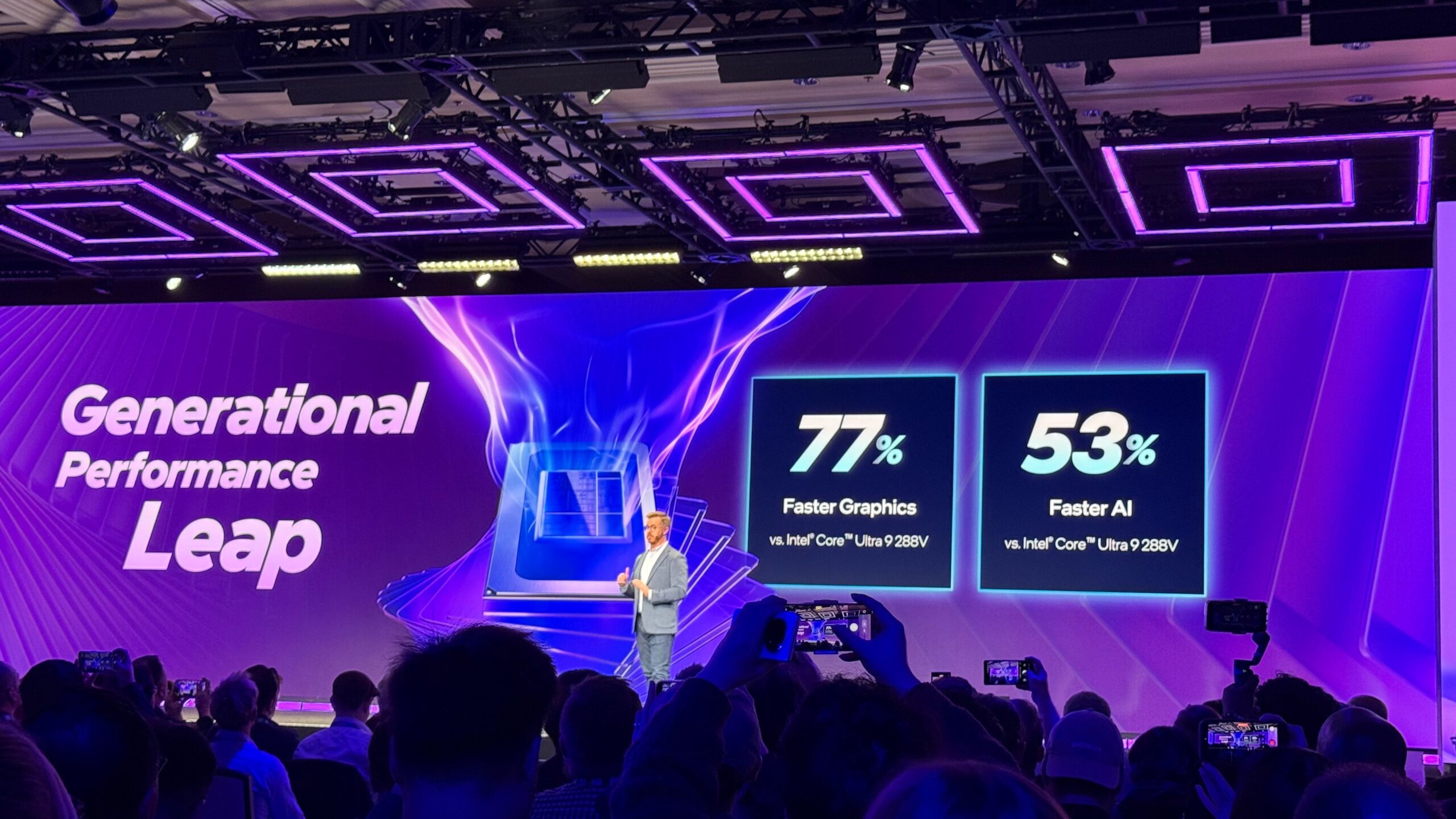
I’m not going to pretend that it’s going to be as powerful as the Core Ultra X9 388H found in the Zenbook Duo, but I do think it’s going to be close. After all, Intel does claim that this G3 chip will be leveraging the full power of the Arc B390 graphics in the 388H, just likely with less CPU cores and maybe a trimmed down NPU (neural processing unit).
We won’t know how Intel is going to spec this thing out until it’s announced, but if it’s the same B390 that’s in Panther Lake, we might be looking at 60 fps gaming in high-end games with high graphics settings. And that’s before Intel’s new multi-frame generation enters the equation.
For instance, in Cyberpunk 2077 at 1200p with the High preset and XeSS set to “Quality”, I was able to get an average of 65 fps in a slice of gameplay from the opening mission. When I turned on frame generation, that number went up to 103 fps with FG set to 2x and 160 fps at 4x multi-frame generation. Now, those higher numbers pushed latency up from 45-55 ms of PC latency up to around 72 ms with 4x frame gen, but I don’t know how much that matters in a single player RPG.

AMD’s Old Architectures
If Intel’s nascent handheld chip does come with the same B390 GPU as its high-end Panther Lake laptop chips, Team Blue could actually pull ahead of AMD. As good as the Ryzen Z2 Extreme is, AMD’s handheld chip uses RDNA 3.5 graphics, which isn’t exactly ancient, but it’s also a generation behind the flagship Radeon RX 9070 XT that debuted at the same time. More importantly, it can’t leverage Team Red’s latest upscaling tech. And that’s the best handheld chip AMD has to offer at the moment.
The rest of the Z2 series of handheld chips is in a much worse position. The regular Z2 is using an RDNA 3 GPU, and the Z2 Go, primarily found in the entry-level Legion Go S, has an RDNA 2 graphics core. For reference, RDNA 2 debuted back in 2020.
In AMD’s defense, it makes sense to pair lower-end processors with older architectures to save cash, but if Intel is coming to market with a handheld chip that offers a faster and more efficient architecture, it’s not hard to imagine that Team Red has to be sweating a little bit. It’s going to be a few months before an Intel Panther Lake handheld gaming PC makes its way to market, but when it does, I’m going to be very interested to get it in the lab to see how it holds up against AMD’s established Z-series chips.
Jackie Thomas is the Hardware and Buying Guides Editor at IGN and the PC components queen. You can follow her @Jackiecobra
