
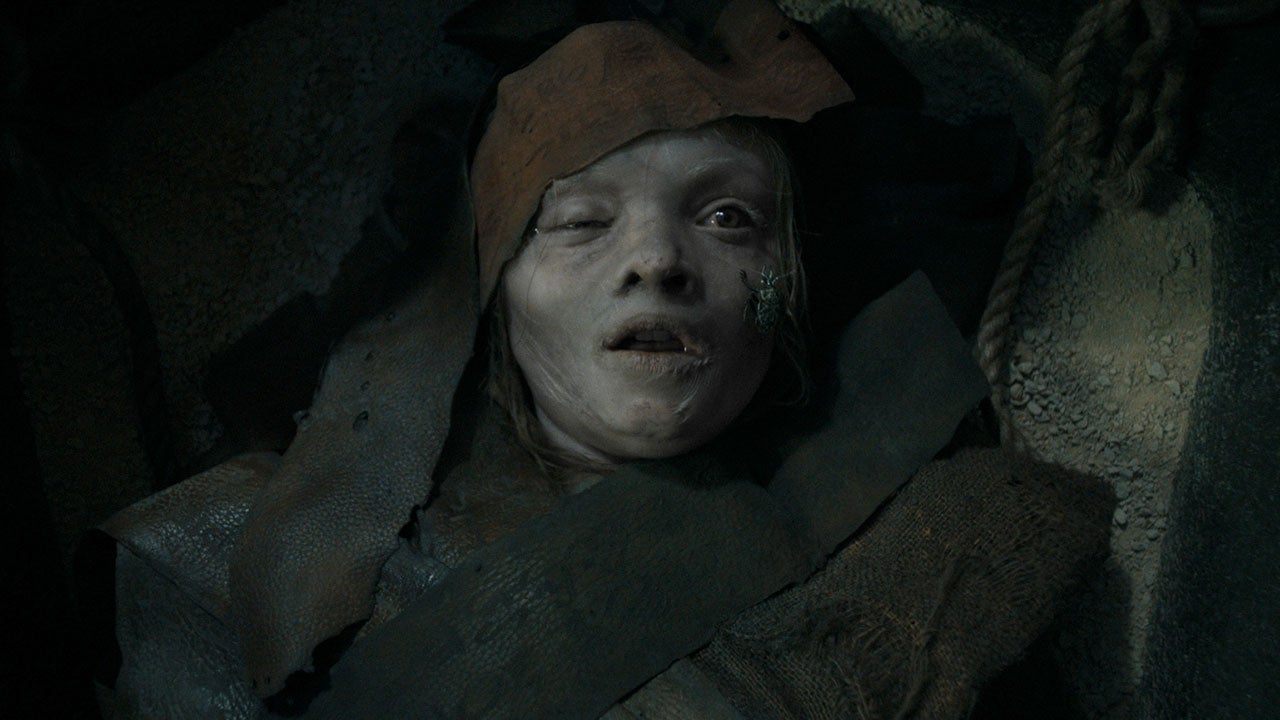
“This is a very different kind of Mummy movie.”
That’s what writer-director Lee Cronin told me during a Zoom call last week about his upcoming horror film, the eponymous Lee Cronin’s The Mummy. And really, it only makes sense that he’d want to differentiate the movie from the many, many Mummy titles that have come before. From Boris Karloff to Christopher Lee to Brendan Fraser and all the way up to Tom Cruise, there have been an untold number of movies involving ancient, cursed burial sites, reawakened if not-quite-alive ghouls, and the heroes who seek to send them back to the land of the dead. And now with Lee Cronin's The Mummy, we’ll be getting a new spin on this age-old concept.
Watch the teaser trailer for Lee Cronin's The Mummy right here:
Cronin made his mark on the horror scene with 2023’s Evil Dead Rise, the fifth film in that beloved and goopy series, and before that with his feature debut, the 2019 Sundance title The Hole in the Ground. But as is often the case with masters of the macabre, the man behind the monsters comes across as an unassuming and affable guy.
“The movie itself really is a mystery and it's a puzzle box, which was part of my draw towards it,” he smiles. “I think for me what's really interesting and exciting, certainly even from childhood and being drawn towards Egyptian lore and that entire world, is the secrets that exist and the hidden things. So the movie that I wanted to make was reflective of that idea of deep, buried secrets and things we may not know about. This movie is coming from a very different place, and it's not even a reinvention of mummy lore; it's looking into darker places and doing something different with what we think we might already know.”
One Part Poltergeist and One Part Seven
“It's an insane mashup to suggest, but [this film is] almost one part Poltergeist and one part Seven, but put through my lens and the way that I like to entertain people,” laughs Cronin.
As noted, there have been a ton of Mummy movies over the years, but they’ve usually been straight shambling monster yarns like the films featuring the bandaged ghoul of (most of) the Universal Monster cycle, or sometimes action-based adventures, as with the Brendan Fraser series or even the 2017 Tom Cruise film. But a Poltergeist/Seven combo package? That certainly sounds new.
“I'm an Amblin kid, a child of Spielberg, no doubt,” says the director. “I was massively influenced by that. So when I talk about Poltergeist, what I mean is the domestic circumstances and the warmth of the family. And when I talk about Seven, what I mean is the dark, investigative angle and the secrets that exist behind it. And they are two aspects within two different tram lines, but two places that I love and I'm trying to bring them together in center court.”
Cronin points out that the movies he writes are always about family – even if they involve resurrected corpses or Deadite infestations. As he puts it, there’s something about “the horror of the domestic” that appeals to him. In the case of his Mummy movie, it’s a story about “people being pulled together and torn apart by something horrific that comes into their world.” He points to David Fincher’s Seven as an example of a film that is not only a classic thriller, but also one that does the work to build up its characters and their world.
“I've always enjoyed watching genre movies that put you into a world that has this familiar quality,” he says. “As brilliant as [Seven] is, it would probably be less good without the two or three scenes of Gwyneth Paltrow and Brad Pitt at home. The little dinner party they have is so important, and the fact that it shows they're trying to be upwardly mobile and yet the train is rattling outside the window. … So even in a movie that you think is just all investigation and all of these crazy moments and these reveals, actually it is underpinned by the strength of those relationships. … The home is always the most valuable way of being able to tie your story down to something that everybody has a connective relationship with.
“So the blending of mystery and horror with the family that we fall in love with was the most appealing thing to me.”
A Bigger Draw Than a Fantasy Monster
Cronin of course did his research when prepping for his take on The Mummy, watching many of the films on the subject that have come before in addition to diving into real-life historical mummy culture. His goal in terms of presenting the iconography of traditional mummy stories was to base the movie on aspects of actual culture and history rather than the older films. Which doesn’t mean he doesn’t have an appreciation for those films.
“I'm drawn towards the fear of the other,” he says, “which, when you go all the way back to the first [1932 Boris Karloff] movie, that idea of something that's existing in the world that isn't quite what it seems to be… I think that was probably a bigger draw than a fantasy monster actually. That there was a grounded quality to it, which again, I always look for that. And if I can ground the story in some way, then it allows me to get quite elaborate with actually the terror and the energy of the horror that plays out as we move forward. So I think that was one of the touchpoints for me – just leaning into that other thing, that uncanny thing, that steps out of the shadows and is there with a purpose as well.”
And while research and historical accuracy is important for Cronin, he stresses that he’s also not in the business of making a “thesis.”
“My goal is I'm always wanting to make really entertaining movies for a mass audience and a global release, and eat popcorn and drink soda and have a good time,” he says. “But the authenticity does matter to me.”
Part of the process then is finding, as Cronin puts it, “gaps” in a topic where he can “wiggle my way into and find a different way of presenting something.” In the case of his Mummy movie, it sounds like one area Cronin wiggled his way into – perhaps the way a worm would wiggle its way into a corpse, or maybe even the way a scarab would wiggle its way out of a mummy – was in the actual reason behind mummification.
“We all have a frame of reference for perhaps why the great and the good or the rich and the famous were mummified in those times,” says Cronin. “But what about the mummification processes and purposes we haven't heard about? … I'll go and hunt about the things maybe we don't know enough about, or take inspiration from something [that’s] a little unspoken, and then go and get really creative with that.”
And so it was this notion that Cronin sparked to when developing the film – what if this mummy wasn't a pharaoh or a king? What if it was an everyday person?
“And what if that person was needed for something else?” he teases.
The Mummy and the Future
Bearing in mind that typically there’s no such thing as a franchise or a sequel until the first entry in a series makes money, the question must be asked: Could Lee Cronin’s The Mummy eventually lead to Lee Cronin’s The Mummy Part 2… and beyond? After all, horror mega-producers Jason Blum and James Wan are behind this film, and they haven’t exactly been shy about franchising their films out in the past.
“One of the things I love about working with New Line is how down to Earth they are process-wise,” says the filmmaker. “And one of the things Dave Neustadter, who's an exec over there, would always talk about [is they] let the audience decide. As in, we make a great movie and then the potential is always there. And you could have a movie in your mind or universe in your mind, and if the movie doesn't cut through with an audience, then all those sequels disappear.”
That said, Cronin does think The Mummy has franchise potential.
“Because it's about a curse. It's about dark history,” he explains. “And not only is there the family that we have in our story and the characters that exist before them, there's also the ripples that could go forward from what they experience in the movie. But also, if you think about discoveries that are made in Egypt and in Egyptian culture, which are still being made all the time… by establishing this dark history, by establishing this story, by establishing this lore, there's no doubt that it could exist in other places and affect other people. Ultimately the success of the movie will decide that, but there is a bigger universe there in the background.”
Lee Cronin's The Mummy will be released on April 17, 2026.
Talk to Scott Collura on Twitter at @ScottCollura, or listen to his Star Trek podcast, Transporter Room 3. Or do both!