Batman was created more than 80 years ago and has starred in video games for 40 of them – nearly half of his existence. But despite a long and varied existence in the comics, ranging from the world’s greatest detective to a hero willing to fight gods and aliens, the dozens of Dark Knight games across the console generations have rarely strayed far from the basics. No matter what decade it is, no matter what hardware you’re playing on, odds are that in any given Batman title you’ll be gliding off gargoyles, firing grappling hooks, and flinging Batarangs at guys in straightjackets.
This year sees one of gaming’s more unusual approaches to Batman – the version made of plastic bricks – return in Lego Batman: Legacy of the Dark Knight, and its exploration of Bruce Wayne’s cinematic legacy has had us thinking of Batman’s long video game journey. So, we’re going on a tour of every Batman game ever made. The good, the bad, and the weird ones. Today, we explore the very start of the rocky, winding road that would one day lead us to the gates of Arkham Asylum…
Batman: Year One (1986 – 1989)
1986 was a turning point in Batman’s long history. It was the moment he would finally shake off the long shadow of the kitschy ‘60s TV series and become the brooding icon he was always meant to be. It was the year that Frank Miller’s The Dark Knight Returns detonated our conception of the character in an operatic flash of lightning and violence and psychiatrist jokes.
In a considerably less seismic development, 1986 was also the year British developer Ocean Software published Batman’s first ever video game: a dinky isometric puzzler on the venerable ZX Spectrum.
In the days before a truly global gaming market, developers in the UK had honed their own unique approach to action: stiff, heavy movements, plodding controls, and a curious fondness for anthropomorphic eggs. You might think this an ill-fit for the Batman, the ninja master who strikes quickly with surgical precision and leaps across rooftops to vanish into the night. You would be correct.
The Joker and the Riddler have kidnapped Robin! Batman, trapped in his own cave and stripped of gadgets, must find the seven missing pieces of his trusty Bat-hovercraft to escape and pursue the dastardly duo. To do so, he’ll have to slowly navigate 150 isometric screens populated by traps, puzzles, and monsters, without any offensive capabilities whatsoever. Rather than the ultra-adept master of everything, here Batman is bereft of even basic video game functionality. Elementary video game verbs like “jumping” and “carrying items” require you to find hidden upgrades around the brutally difficult maze, rendered in a neon Zur-En-Arrh nightmare of teals and yellows and purples. A superhero power fantasy it is not.
Such an odd start was only the beginning, as 1988 saw Ocean publish the second of its three Dark Knight games, Batman: The Caped Crusader. The first of many, many sidescrolling action games to come, Caped Crusader consists of two separate scenarios pitting the Dark Knight against the Penguin and Joker. Batman can now kick rats, throw Batarangs, and flail listlessly at the hordes of identical henchmen clogging your path through agonizing, samey-looking mazes.
There’s certainly more sauce on display than Ocean’s previous effort. The game’s main selling point is its unique interface inspired by comic panels, where the screen is divided into narrow boxes through which the characters traverse. It’s an admirable, if not always pleasant, innovation that made a genuine attempt to convey the comic experience, and you can understand why Ocean tried it. Comics were pretty much all Batman was known for at the time, save for Superfriends cartoons and old memories of Adam West. That was about to change.
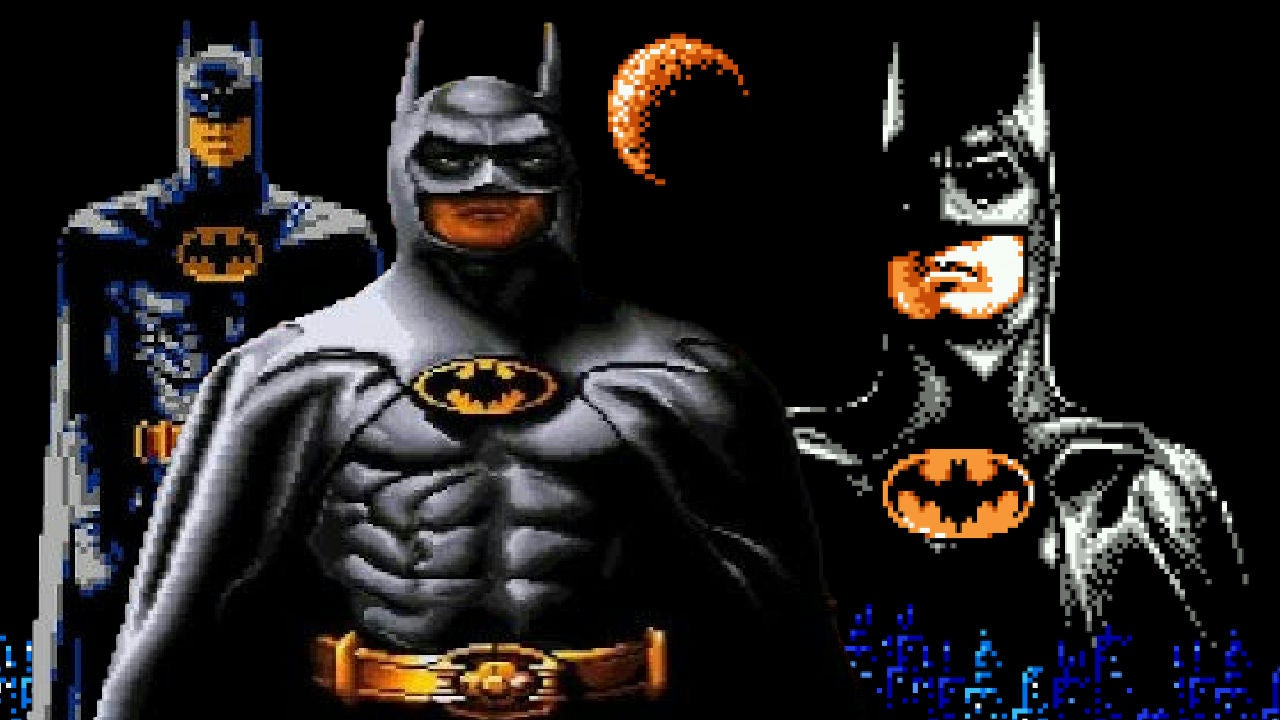
Tim Burton’s 1989 Batman movie was a watershed moment for the character. For the first time in decades there was a definitive Batman in the popular imagination. Game designers finally had something they could work with. Batman: The Movie the game was Ocean’s swan song, and easily the best title of this primordial bunch. The studio slapped Burton’s iconography on a sequence of five minigames, each inspired by a set-piece from the film. The sidescrolling action is vastly improved– Batman can now fight and jump simultaneously as the grappling hook makes its video game debut. More significant is the first appearance of a fast-paced Batmobile shooting gallery, soon to be a franchise staple. There’s even a charming breather on the Bat-computer where Bruce mixes chemicals around, the first real glimpse of the master detective in digital form.
Batman was big business in 1989, and the game was a smash hit across seven different PC platforms, particularly as a pack-in for a best-selling Amiga 500 bundle. The first good Batman game had arrived, but it would be Ocean’s last patrol of Gotham. The British developers would take the back seat, for now, as the license passed to another island nation with its own very distinct approach to game design.
The Sunsoft Rises (1989 – 1991)
Batman is at his best when he is in control, and it’s hard to embody the world’s second-greatest martial artist on the ZX Spectrum’s squishy rubber keyboard. Thankfully, by 1989, Japanese developer Sunsoft had become fully fluent in Famicom, and Batman would be its masterpiece.
The finished NES game bears little resemblance to the Burton movie’s plot, pitting Batman against a bizarre bullpen of deep cut DC criminals like Killer Moth and Electrocutioner. The second-to-last boss is a z-lister named Firebug, and when you finally face the Joker he summons lightning bolts from the sky, a feat, to our knowledge, Jack Nicholson is not capable of in the film. The game has a ton of personality, but it’s not really Tim Burton’s baroque gothic pulp. There’s an almost “Final Fight” vibe to Gotham’s criminal chaos, over-the-top urban combat energy where the final boss taunts you from a video screen in the penultimate level.
Most of these departures are welcome, especially when it comes to feel and mechanics. Batman marches across the screen in a flurry of punches and kicks and three distinct subweapons, including a highly dubious “spear” gun. The Dark Knight leaps from wall to wall like he’s Ryu Hyabusa. Sunsoft’s Batman earns its comparison to Ninja Gaiden not just in feel but in the cinematic cutscenes that punctuate each stage, if you can survive long enough to reach them.
Sunsoft pounced on the huge success of its first Batman game and spread the love to several other platforms over the next year. A perfectly adequate adaptation of Batman for the Sega Genesis skewed more towards the slow and deliberate Shinobi style vs. the twitch mastery of Ninja Gaiden, while a fairly obscure arcade version looked great, but suffered from early beat-em-up awkwardness with hundreds of goons pouring from doors to suck down your life and quarters. Both were notable for their inter-level Bat-vehicle sequences: sidescrolling shmups on Sega’s console and flashy first-person extravaganzas to turn heads at the arcade.
Batman for Game Boy was another totally new game, with miniature sprites of a gun-wielding Dark Knight riddling his tiny foes with bullets. Video games don’t have the best track records when it comes to Batman’s strict aversion to firearms, but Batman on Game Boy is among the more comical dismissals of the trope.
There’s one more Batman game in Sunsoft’s pocket for the first Batman movie rollout, and it’s a darn cute one. In Batman for the PC Engine, the Dark Knight is embodied as an adorably chubby avatar who putters around top down mazes dressed to look like city streets and art museums. Batman scoots around collecting powerups and cleaning paint, twirling bad guys with his Batarangs and booping them away.
We’ve seen a silly-looking Caped Crusader before, but this is very specifically supposed to be Michael Keaton’s intense and raw avenger. This weird little guy, more Bomberman than Batman, is embodying the same person who screams and smashes vases and hooks up with Kim Basinger. The game is harmless fun, with another excellent soundtrack, but the real joy comes from seeing digital stills from the film fade into the cheerful little goblin we control, or watching a chibi sprite coldly send the Joker plummeting to a grisly death.
Pure Dynamite (1991)
Batman Returns was still a year away in 1991, but Sunsoft skipped the line and issued its own sequel. Without a movie to adapt, the team ditched the Burtonian gothic atmosphere in favor of full throttle run-and-gun spectacle. In the West, it was called Return of the Joker, but the Japanese title tells the real story: Dynamite Batman.
Return of the Joker looks and plays like Mega Man, Castlevania, and Contra fell into a vat and emerged as an awesome, amalgam creature with parallax scrolling and enormous sprites. There’s a sequence beneath a blimp that seems like it belongs in Sonic 3, with levels set in snowfields and speeding trains and blazing fast shooter sequences that are giving 16-bit blast processing on the 8-bit NES. Batman’s primary weapon is an arm-mounted cannon, and while it technically isn’t a gun in the traditional sense, slamming powerups into the deadly machine gun on his wrist seems outside the spirit of Batman’s solemn vow. It feels right at home within the context of a Dynamite Batman, however, one who enters boss battles following a fighting-game style versus screen and begins each fight by charging up with red lightning.
The final confrontation with the titular prodigal clown sees the Joker ensconced inside a Dr. Wily spaceship with a ludicrous 250,000 hit points, sending off Sunsoft’s Batman saga in style, even if the publisher wasn’t finished quite yet. Two more bites at the Bat-apple remained.
First came the Game Boy edition of Return of the Joker, which is completely different from its NES namesake. It feels like a hastily repurposed unrelated ninja action title slathered with a bat coat of paint, judging from the Shogun Warriors and samurai the Dark Knight disposes of within.
The Genesis version is perhaps even worse. Farmed out to an American studio under an extremely tight deadline, the 16-bit port, inexplicably rechristened Revenge of the Joker, suffers from clunky controls, muddled graphics, and difficulty that has been increased to the point of aggravation. Even Tommy Tallarico’s soundtrack is a rare miss, with Sega’s gormless Yamaha soundfont unable to compete with the crunching pulsewaves of Sunsoft’s 8-bit output.
Revenge of the Joker sounds and feels like an exhausted sigh from a publisher who had wrung everything it could out of the Burton IP. It was time to move on, and the timing couldn’t be better.
Many Happy Returns (1992)
If 1989 was the year of the Bat, 1992 was the year of the cat, the bird, and the silver-haired industrialist. Burton’s indulgent, uninhibited sequel wasn’t quite as massive as the first, but the marketing machine established in ‘89 managed to churn out an entire starting lineup’s worth of video games.
Nine different Batman Returns games were made by six different developers and released by five different publishers. Nine unique, bespoke games tailored to each system, wildly differing in quality. Today’s IP tie-ins are developed over years at enormous cost and ported to increasingly indistinguishable hardware, but in 1992, it meant whatever six studios could ship before the movie left theaters.
First came Batman Returns on the Sega Genesis, developed by Malibu Interactive. Some of its talent was recruited from former Bat-devs Ocean, but the Batman Returns game they made bore a greater resemblance to Sunsoft’s Genesis offering. It’s a somewhat slow, sidescrolling, punch-kickey platformer with gadgets and grappling and a limited glide. Batman progresses through streets, sewers, and circuses, settings mind-numbingly shared across the entire spectrum of Returns games, though there are some cool setpieces like sliding through the slanted halls of a ruined building.
Sega’s Batman Returns is plenty cinematic, with cool touches like fighting the giant art deco statues from the film as firebreathing bosses and a final battle against Catwoman as the credits roll. But the sound lacks impact, and enemies die not with a gurgle or a thud but a synthesized bleat. It’s a solid if uninspiring package, and if you feel like it lacks automotive action you can pop in the Sega CD version, which adds 3D Batmobile sections and better sound to the original game.
Batman Returns on SNES is a Final Fight clone in cape and cowl, with big sprites, juicy hit stops, and beefy sound effects as you beat the crap out of a legion of identical clowns. You can bash their heads together, hurl them through plate glass windows, or cleverly recreate moments from the movie with your trusty grappling hook. Between the screen-clearing powerups, multiple elevator stages, and enemies with their own named lifebars, it’s a Konami belt-scroller through and through, but it’s far from the best. Boss battles are a bit of a bore as you face the Penguin and the Catwoman multiple times throughout the relatively short runtime.
It’s hard to say which platform had the better Batman. Like the other dueling licensed games of the era, your decision will likely lean towards the console you grew up with. If you bore allegiance to neither SNES nor Genesis, however, there were plenty of other Batman Returns games available. They just weren’t going to be as good.
Konami’s own NES effort is commendable, a shrunken-down beat-em-up in the mold of Double Dragon. The similarly obsolete Sega Master System and Game Gear each received their own fairly-decent 8-bit platformers, while Atari’s handheld Lynx featured an extremely simple side-scroller that’s barely more complex than a flip-phone game. On personal computers, an infamous Amiga version ranks among the lowest dregs of Bat-games, a buggy, nonresponsive mess that’s entirely unfun and unmemorable beyond giving you permission to punt poodles.
Rather than another 2D platformer, the MS-DOS version from developer Spirit of Discovery was a point-and-click adventure. Batman walks around the screen like he’s in a Lucasfilm game, though the Dark Knight isn’t one for witty banter, preferring shambling fisticuffs to insult swordfighting. It’s an odd, interesting precursor to the kinds of narrative adventures future technology would make possible. It boasts some pretty clever detective action: solving puzzles, staking out crime scenes, and interrogating crooks interrupted by agonizing combat sections. The Batcomputer is your best friend here, poring through archives and “video” footage to unravel the Penguin’s bid for mayor and expose the evils of Max Schreck. It’s a rare excursion into the side of Batman’s job that doesn’t involve giving people concussions, and one that would be explored heavily in the years to come, when Batman would finally become a video game trailblazer, rather than the victim of countless tie-ins.
Our exploration of the history of Batman games continues tomorrow, when we'll take a look at how the Dark Knight coped with his greatest nemesis: suits with nipples.