
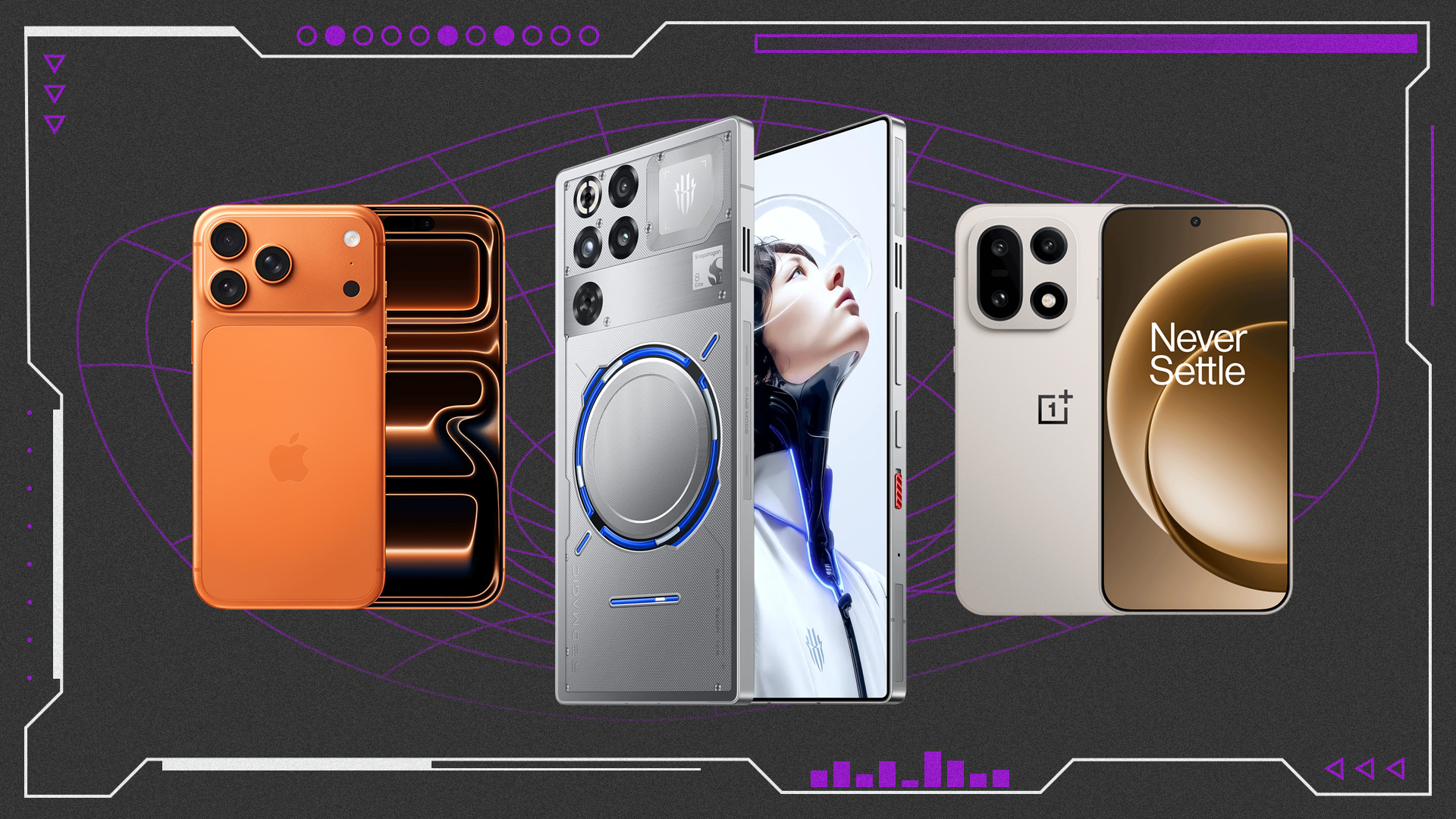
While just about every phone you can get your hands on nowadays will be able to play some games, several key features distinguish a fine gaming phone from a great one. Powerful processing is one piece of the puzzle. Being able to sustain high performance levels is also a must – you don’t want to deal with a phone that can only run smoothly for a few minutes before it slows down and scorches your hands. Extra memory and storage are also clutch for gaming phones, providing a means for multitasking even while you have a game running and giving you plenty of space for games. Some gaming phones, like the RedMagic 11 Pro, even offer extra upgrades for gaming, like additional shoulder buttons and enhanced touch sampling rates. (Though you could also just pick up a dedicated phone controller.)
Of course, the display is also a big piece of the puzzle. If you can’t see your games, you’re going to have a hard time playing them. A bigger, brighter display helps, as does a boost in refresh rate for smooth motion. An added benefit of a bigger phone is that your thumbs won’t cover as much of the display when you’re using touch controls. I've been testing and reviewing gaming phones for years now, so with all these details in mind, here’s a look at the best smartphones that also excel when it comes to gaming anywhere, anytime.
TL;DR – These Are the Best Gaming Phones:
1. RedMagic 10 Pro
Best Gaming Phone
RedMagic has shown a perennial knack for delivering gaming performance at class-leading levels, and the RedMagic 11 Pro takes the torch from the 10 Pro and carries it further still. This generation not only benefits from the latest Snapdragon 8 Elite Gen 5 SoC for the most powerful phone hardware we’ve seen yet, but it doubles down on making the most of that hardware by throwing its signature air cooling system at it alongside a new liquid-cooling loop. The results are phenomenal, with the best benchmark scores we’ve seen and sustained performance in games without breaking a sweat.
Where most phones will see their performance quickly sink under a heavy load, the RedMagic 11 Pro proved capable of sustaining higher speeds for longer. Benchmarks were one of the only things that could really give the phone a workout, as it never seemed to get as hot or reduce speeds as much while playing actual games.
Performance is only one consideration, though. Thankfully, RedMagic doesn’t come up lacking in other key areas. The phone’s display is excellent. It provides a spacious canvas to view games, offering them vivid and punchy color and contrast thanks to its bright OLED panel. RedMagic also uses an effectively invisible selfie camera that hides underneath the display so that you get a truly uninterrupted display. By adding shoulder buttons onto the edge of the chassis, you also get better control in your games.
The cameras leave plenty to be desired, but that’s a typical trade-off you’ll find on any gaming phone. On the bright side, the RedMagic 11 Pro isn’t actually asking for a big premium to deliver such exceptional gaming bonafides. The phone has a starting price of $749, undercutting just about anything else you might be considering for competitive performance levels.
2. OnePlus 15
Best Everyday Phone for Gaming
RedMagic may take the cake for performance, but when it comes to overall appeal, the OnePlus 15 is a far more well-rounded phone. Thankfully, it still has the performance gamers require, packing in the Snapdragon 8 Elite Gen 5 SoC. It doesn’t quite keep up with RedMagic, but it’s not trailing far behind most of the time, and it leapt ahead of every other phone we’d tested prior. That speed translates wonderfully into games, where the phone readily handles the most demanding Android games without much fuss.
OnePlus lacks the almost absurd cooling hardware of the RedMagic 11 Pro, but it has a decent enough solution that avoids too much heat buildup during regular use and gaming — though benchmarks can put it over the top. It makes up for that omission by being an excellent phone all-around.
The OnePlus 15 includes a brilliant OLED display that runs at 165Hz for extra smooth visuals. It includes a massive battery for multi-day battery life. The triple-camera system on the rear hasn’t improved on the OnePlus 13 meaningfully, but it’s still a worthy setup that can compete admirably with Google and Samsung phones. Network connectivity and long-term software support are also on the high-end for Android devices, if not quite matching Google, Samsung, or Apple. Overall, there’s not a lot the OnePlus 15 does poorly, and the gaming performance it delivers on top of that well-rounded experience makes it a great choice for those who want a killer phone with the option to game.
3. iPhone 17 Pro Max
Best iPhone for Gaming
Mobile gaming calls for a couple of things: extreme performance and a great display. Where iPhones are concerned, the iPhone 17 Pro Max delivers the best Apple has to offer in both categories. Offering a massive (for smartphones) 6.9-inch display, the 17 Pro Max benefits from 120Hz ProMotion smoothness, ample sharpness, and a vivid OLED panel so bright that our reviewer flashbanged herself with it.
Performance is also its strong point. The A19 Pro chip in the iPhone 17 Pro Max packs six CPU cores and six GPU cores, which make for small performance upticks over the earlier iPhone 16 Pro Max but will be a much more considerable boost for anyone coming from older models. The iPhone 17 Pro Max is still lagging slightly behind some of the Android phone options running the Snapdragon 8 Elite SoC in multi-core performance and 3DMark benchmarks (like the RedMagic 10 Pro and OnePlus 13 included above) and that gap is likely to widen further, thanks to the Snapdragon 8 Elite Gen 5 landing in phones. But that’s not enough to hold the iPhone 17 Pro Max back as a great option for gaming, as plenty of developers optimize their games for iPhone, and the performance on deck here holds up well in even the most demanding games.
In our testing, heat was still an issue, as it is for most phones, but the iPhone 17 Pro Max still managed it well enough. In 3DMark’s Steel Nomad Light stress test, the phone quickly lowered its performance after one run, but then largely sustained for the remaining 19 runs. That’s fairly typical behavior from a phone that doesn’t have active cooling (a rarity) or simply throttles its performance from the start. Crucially, the phone’s extensive aluminum frame and vapor chamber do a good job of spreading heat, so even though the phone gets warm while gaming, our reviewer didn’t find it having any serious hotspots.
What helps make the iPhone 17 Pro Max more worthwhile is that on top of its credentials for gaming, it’s also a powerful device in other respects. It’s built sturdy, it has a great set of cameras, and it should get the same kind of long-term support that has been a standout feature of iPhones for many years.
4. iPhone 17e
Best Budget iPhone for Gaming
You don’t have to buy the most expensive iPhone to get a solid gaming experience. The iPhone 17e trims down from the mainline models in a number of ways, but it still has a potent A19 processor. It loses one of the graphics cores, which hurts gaming performance somewhat, but it’s still overall a strong option for $599.
In our iPhone 17e review, the phone showed its CPU was definitely up to snuff, even keeping good pace with the iPhone 17 Pro Max. For everyday operation, that’s great news. Its gaming performance doesn’t quite keep pace with some of the higher-end Android phones out there with Snapdragon 8 Elite and Snapdragon 8 Gen 3 or Gen 5 chips and the corresponding GPUs. But it’s still capable, holding up in Where Winds Meet with Ultra settings, which it sustained at a stable 30fps without hardly getting warm after a half hour. For lighter games, the iPhone 17e shouldn’t break a sweat.
The iPhone 17e puts all of that gaming on display fairly well. Its 6.1-inch display is sharp and has the great color and contrast of OLED. It’s a shame that it tops out at just 60Hz, so you won’t get to experience ultra-fluid visuals, but plenty of mobile games don’t let you go beyond 60fps anyway, so it’s not always going to be an impactful limitation for the iPhone 17e.
Another perk of the iPhone 17e is that it comes with a base storage of 256GB, giving it a big bump over the iPhone 16e’s base storage. That means plenty of room for apps, games, and media. Since one of the iPhone 17e’s big sacrifices is its single rear camera, you probably won’t be trying to fill the storage up with photos and videos anyway.
5. Samsung Galaxy Z Fold 7
Best Foldable Gaming Phone
Sometimes you just want more screen to see all the glory of your favorite games, and the Samsung Galaxy Z Fold 7 that I reviewed is just the ticket. This foldable phone has an 8-inch interior display that stretches games across it, and while that may not work for everything, you can still use its exterior display for gaming too – that one is a more normal 21:9 display. Regardless of which you use, both screens will highlight the rich contrast and bold color of an AMOLED display, not to mention the smooth visuals that come with a 120Hz refresh rate.
To power your games, the Galaxy Z Fold 7 packs in a Snapdragon 8 Elite chipset. This is the same hardware you’ll see in many of the best gaming devices that came out in 2025. Between the powerful Oryon CPU cores and the Adreno GPU, this chip offers extreme performance for smartphones and tablets alike or, in the case of the Galaxy Z Fold 7, both types of devices in one device. If you really want to go all out, you still will be better off with a tailor-made gaming device. The Galaxy Z Fold 7 has bursty performance, but under heavy sustained loads, its thin design will heat up and see performance drop off by as much as 60%. Thankfully, plenty of Android games don’t take full advantage of the hardware just yet, so there’s a good chance you’ll get to game without feeling this specific shortcoming.
The flipside is that the Galaxy Z Fold 7 is much more pocket-friendly than its predecessor. This folding phone sits at just over 4mm thick open and it folds shut to measure just 8.9mm thick. That’s the same thickness as the Asus ROG Phone 9.
While the Galaxy Z Fold 7 may not have the same gaming chops as dedicated gaming phones, it will provide a more well-rounded experience. So if you’re also looking for solid cameras and long-term software support, you can expect it here. Of course, with a $1,999 price tag, I’d still point anyone who didn’t need one device to serve as a gaming tablet and phone toward separate purchases of a OnePlus 13 and Redmagic Astra tablet, which will cost less combined.
6. OnePlus 13R
Best Budget Android for Gaming
If you’re looking to get solid gaming performance while saving a bit, the OnePlus 13R is still a great bet. It’s not the option from OnePlus, as it has been superseded by the OnePlus 15R, but that’s what’s helping make it a bargain. The OnePlus 15R is just a little too expensive, costing nearly as much as the RedMagic 11 Pro. Meanwhile, the OnePlus 13R is still being sold and has seen its price floating around a tempting $550.
At that price, it's a good bargain for gaming. It runs on the Snapdragon 8 Gen 3 chip, which has plenty of performance for most games. The phone could readily run Wuthering Waves at maxed out settings around 60fps. And everyday operation is a breeze for it. Plus, with a 6,000mAh battery, it’s good to go for long gaming sessions.
The screen on the OnePlus 13R is also excellent for gaming. It’s a big, 6.78-inch display provides plenty of space for your thumbs while giving an excellent view of your games. It’s sharp and very bright, plus it has a 120Hz refresh rate for smooth visuals. It’s also an AMOLED panel, so you’re getting vivid colors and perfect contrast.
Although the OnePlus 13R doesn’t have the most impressive camera system, it still rounds out the feature list with a decent assortment, including an ultra-wide sensor and a 2x telephoto sensor. While plenty of gaming phones are lucky to have cameras that aren’t bad, the OnePlus 13R lands squarely in decent territory.
What to Look for in a Gaming Phone
Once you're certain you're a prime candidate for a gaming phone, here's exactly what to consider when you're on the hunt for one. While the best smartphones on the market tend to have some of what it takes to be a decent gaming phone, proper gaming phones tend to have some considerable advantages. You’ll find unseen benefits under the hood, upgrades to the screen and battery, and even extra controls to help give you the edge while gaming.
Processors
This is a key area for gaming phones as they effectively define how well a phone can run a game. Top-tier chips like those from the Snapdragon 8 family (e.g., Elite, Gen 1/2/3) tend to be strong performers in games, and the recent Snapdragon 8 Elite and 8 Elite Gn 5 have shown themselves to be absolute beasts when it comes to gaming. Apple’s iPhones also tend to have pretty high-performance chips, with any model within the last year or two often providing more than enough speed for the latest games.
Cooling and heat management
While a fast processor is a good start, running games is demanding and generates heat. Gaming phones generally make a point of managing that. Paying attention to sustained performance is a key part of how we test phones’ gaming potential. The OnePlus 15 may have great performance in a short benchmark, but it slows down considerably as it heats up. Meanwhile, a top-notch gaming phone like the RedMagic 11 Pro can lag behind OnePlus in some benchmarks, but proves itself capable of sustaining its performance for the long haul thanks to powerful heat management in the form of an active cooling phone — something most everyday phones won’t have.
Power
Sometimes it’s not about hardware when it comes to smartly managing heat. You should be on the lookout for pass-through power when shopping for a gaming phone. This feature lets you plug in your phone and have the chipset draw power directly from the outlet, skipping the battery and avoiding the extra heat this would create while also letting you game nonstop without worrying about running out of charge. But again, this isn’t something you can count on every phone offering.
Display
Most gaming phones will give you a solid display for gaming. This will include a high resolution and refresh rates ranging from 120Hz to 165Hz or above. Most often, these will be OLED displays, giving you rich contrast and limited motion blur. While many games have framerate caps at 60fps, not all do, and the extra frames can make a world of difference in the perceived smoothness of a game. Quite a few gaming phones also offer high touch sampling rates, ensuring your inputs are registered quickly, and with games often calling for split-second reaction times, this can make a difference.
Gaming-specific features
Finally, good gaming phones often find ways to make themselves extra useful in games. This often comes in the form of extra software that’s not always pleasing or easy to use, or extra buttons on the phone that let you use more than just your thumbs as inputs. Even with just a pair of shoulder buttons on a gaming phone, you end up with double the input methods you’d have otherwise, and the ability to move, aim, jump and fire all with separate fingers in online FPS games, for instance, makes a big difference.
Gaming Handhelds vs. Gaming Phones
Deciding on a portable gaming device truly depends on your lifestyle, the type of games you want to play, and how you want to play them.
A gaming phone is ultra-portable and easily pocketed. However, it’s still a highly capable machine that does more than game, offering all your typical smartphone features, including quality cameras, navigation, and communication. Gaming phones also better support cloud streaming for Steam, PlayStation, and Xbox games. Many gaming phones even have cooling solutions to prevent thermal throttling and some handy triggers. If you’re not a fan of touch controls, you can always grab a phone controller and get an experience much closer to a gaming handheld.
Gaming handhelds, like the Steam Deck or Nintendo Switch, are substantially bulkier but still easy to toss in a bag and take on the go. Unlike gaming phones, they are pretty much used solely for gaming, so you get responsive joysticks, triggers, and buttons with these options.
As for actual games, there’s a considerable rift. Android and iOS get plenty of games, and it’s becoming increasingly common to find the same titles on mobile and PC, though the mobile versions are often scaled back in some ways. Gaming handhelds get access to pretty much all of the PC games out there because they are, in fact, gaming PCs (except the Nintendo Switch, of course). Some PC games won’t run well (or run at all) on the low-powered hardware of the gaming handheld, though.
Both gaming handhelds and gaming phones can tap into cloud gaming platforms like Nvidia GeForce Now and Xbox Game Pass. In these, the performance of the phone and handheld don’t matter nearly as much as the quality of their internet connection. In that sense, phones can get an advantage as they offer both Wi-Fi and cellular connectivity (though a very good 5G connection is all but essential to try game streaming).
Battery life can be a tossup. Gaming phones tend to have sizable batteries, run efficiently, and can easily last through the day even with a bit of gaming sprinkled in – otherwise, what use is it as a phone? Gaming handhelds tend to last just a few hours, with the Steam Deck offering pretty poor battery life as an example. And topping up the battery on the go will be easier for the phone, which won’t require a high-wattage charger.
Cost is a big question. The Steam Deck starts at $400 and the original Nintendo Switch is even less than that. Most gaming phones cost more. But some gaming handhelds are landing with prices closer to $1,000, and that far outpaces some of our favorite gaming phones. Plus, most of us need a phone whether we get a gaming handheld or not. The fact a gaming phone can pull double duty should weigh into its value.
The limited access to games may be the deciding factor, as even with cloud gaming as an option, some games simply won’t be available for gaming phones. If everything you want to play is available on mobile or cloud gaming, then it’s worth testing the waters of cloud gaming with your current phone and then, if you like the experience, considering a gaming phone as your next device. If you can’t play the games you want the way you want, then a handheld may fit the bill.
Mark Knapp is a contributing freelancer for IGN covering everything electronics and gaming hardware. He has over 10 years of experience in the tech industry with bylines at PCMag, Reviewed, CNET, and more. Find Mark on Twitter @Techn0Mark or BlueSky at @Techn0Mark.
