
Playground Games has grown.
When I first visited the studio in 2014 for Forza Horizon 2, the crew still shared their building with a variety of other businesses. In 2018, when I again flew over to the UK for an early peek at Forza Horizon 4, there was a whole wing of the building filled with developers beavering away on something entirely secret and apparently unrelated to Forza Horizon. Remaining none the wiser, I was escorted past this area with a coy grin from Playground Games co-founder Ralph Fulton – now the director of this year’s highly anticipated Fable.
Today, in 2026, much has changed. Since my last time as a guest, Playground Games now operates in three separate buildings around Leamington Spa, all within walking distance of each other. The team no longer shares its original building with anyone else, either. With Fable being developed across town, every part of Playground Games’ original Rossmore House facility is now devoted to Forza Horizon. The rooms I’m toured through feel familiar to me – packed with desks, dev kits, and diecast cars – but now there are simply more rooms.
Make no mistake: Playground Games is bigger than ever.
So, as it happens, is Forza Horizon 6.
We’ve known for some time that Forza Horizon 6’s Japan is Playground Games’ largest and densest map to date. We’ve known, too, that Playground Games’ version of Tokyo City is set to be the biggest urban space the team has ever made, and five times larger than Forza Horizon 5’s Guanajuato.
Seeing it in person, however, is something else – and obviously extremely exciting. My first showcase of the game in action features a beaming red GR GT – the cover car for Forza Horizon 6 – threading its way from the map’s southern end to the north, up through the outskirts of Tokyo City and onwards to Japan’s Alps. For some stretches I watch as the team drives, and for others they defer to Forza Horizon 6’s new auto-drive accessibility feature. It’s a feature that came about in order to help players with finite energy they want to save for racing and events; energy they may be hesitant to exhaust by driving across the map to reach them (although art director Don Arceta jokingly concedes he’s found himself using it to eat snacks at times).
As with all previous Forza Horizon maps, this is not a 1:1 facsimile of any specific chunk of Japan; it is a greatest hits tour that captures the look and spirit of areas from all over the country, all bundled into a single racing sandbox. From the perspective of someone who has only ever experienced Japan as an occasional visitor, it is instantly convincing. As someone who loves the ability of video games to authentically place me somewhere in the world, I am immediately transported. The colour palette. The road markings. The recognisable bridges. The distinct vegetation. The team has the season set to spring for my very first glimpse of the game in action, which results in zipping past clumps of iconic blossom trees. In the sliver of the map we toured through they appeared satisfyingly occasionally, meaning they remained a novelty when they did so. That is, Playground Games has not turned springtime Japan into an unrelenting and inauthentic sea of non-stop pink – even if pink is the longtime hero colour of the Horizon Festival.
My general interest in Japan itself does not dwarf my interest in other places around the world famous for their scenic driving opportunities, and I should probably clarify that I’m not the sort of person whose admiration for Japan and its culture is the core defining part of my personality. Yes, I love ’90s JDM cars, Godzilla movies, and Japan’s massively affordable konbini beers when I visit. However, I don’t watch anime, I bounce off JRPGs, and… I hate raw fish and cold rice. I’m also way too tall for Japanese public transport, and I have a scar on my head because of it.
I do, however, firmly believe that Japan is an absolutely excellent setting for a Forza Horizon game.
“It’s one of the first decisions we make and it’s historically one of the toughest decisions to make because, as you say, it informs everything,” says design director Torben Ellert. “And there are many components to it that we’ve spoken about at length, but Japan has been a location we’ve wanted to do and it’s been on our shortlist for a number of games. But I think this was the first time that we felt that we could take a shot at it; that the fear was healthy rather than an actual panic response.”
“Each location offers new challenges, and obviously new gameplay and new experiences, but, for this one, Japan had a lot of challenges that we had to figure out and approach and try to solve,” adds Arceta. “And that was one of the things that, at least for myself, intrigued me to tackle Japan as a location.”
One significant rule that the Playground team took specific care to abide by was the fact that simply transplanting the Horizon Festival to Japan and dusting their hands couldn’t be enough. As highly desired as the location was, it could never be the only thing Forza Horizon 6 brought to the table. Happily, Ellert points out that the location does, in fact, give the team a lot of scope to make new features – which is something he cares deeply about.
“I think a lot of the discussions that we had all the way back in concept for this project were around, ‘Is it just Japan? Is it a previous game that is on a new map?’ says Ellert. “And our games are never like that. We always iterate, always innovate. We always introduce new features and push the game forward.”
“So, certainly from a design point of view, we were very careful and very aware of the fact that we needed to think about this as a game that was set in Japan, rather than that being almost like a core part of what the game would be. We couldn't rely on it being Japan. We wanted this to be the most innovative Forza game that we’ve made; the most exciting game. The game where we push on a bunch of different axes and generate these new features that players would be really excited about. And it’s also in Japan.”
“Japan comes with so many expectations and everyone has their idea of what Japan is,” adds Arceta. “So, obviously, we had to look at those things, like Tokyo City and what they expect – and obviously mountainous roads, which both offer huge challenges for our team technically and gameplay-wise.”
“But it’s also trying to find the things that will surprise and delight players, and things that people don’t immediately think of Japan when they say it. And I think, as with all Horizon games, we always look for those in every location that we choose. For Japan, it’s no different. We have those nice surprises, and we’ve seen it with the footage we've shared so far. People are, like, ‘Does that exist? Is this for real?’ And it does exist in Japan, which is really exciting.”
Not too far into the tour, the GR GT reaches Forza Horizon 6’s version of the real-life Kawazu Nanadaru Loop Bridge – a unique, two-story structure that winds into the sky like a giant Hot Wheels track.
“You probably saw this in, I think it was in, the [Developer_Direct] trailer,” grins production director Mike Bennett. “Like, you just know the amount of drift videos we’re gonna get on this road, and I’m so looking forward to it.”
Some time after negotiating the bridge, the first hint of the Tokyo City skyline appears in the distance.
“This flow into the city here is part of how we thought about defining this Tokyo City as a set of experiences,” explains Ellert. “You see it in the distance, on the horizon. You approach it. You drive through suburbs and skirt around the middle of it. You move up onto the freeways and, if I was to turn left, you go down through downtown and the centre of the city.”
“Rather than try to 1:1 rebuild a place we create the individual elements of the experience of driving to a place.”
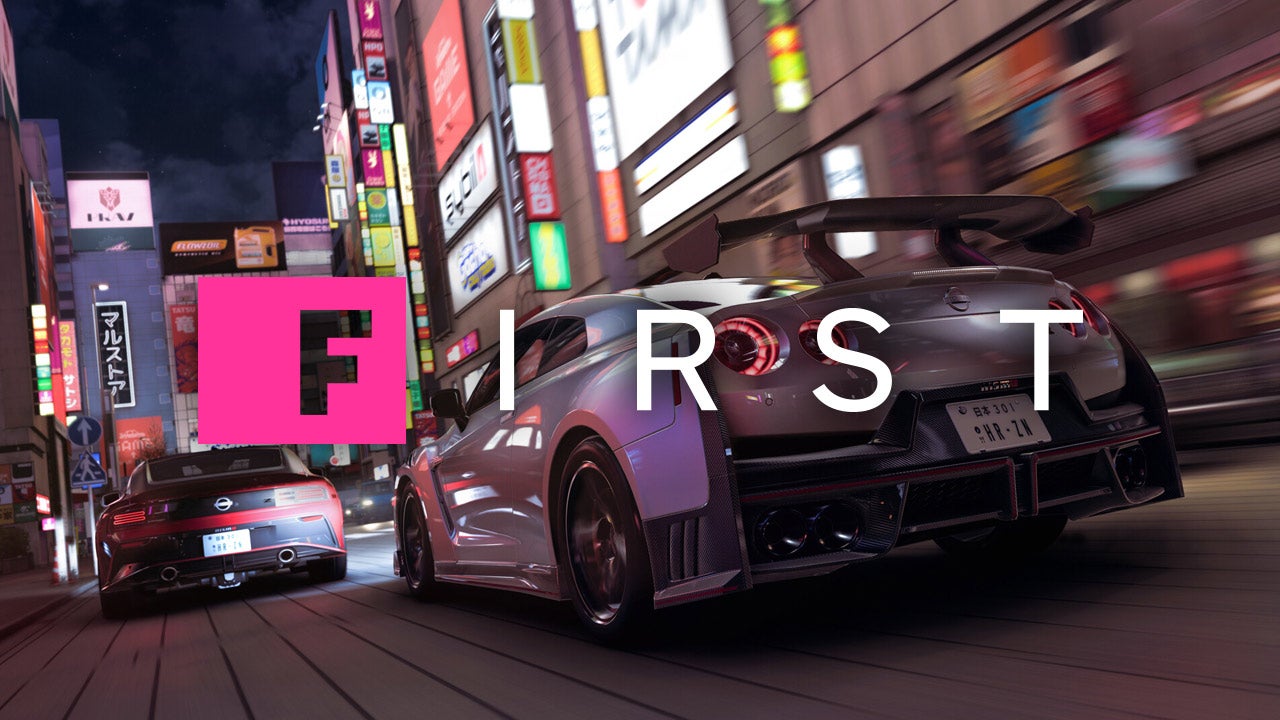
Entering Tokyo City I’m taken aback by just how vastly different it is to previous Horizon game urban spaces. This is spectacularly different from Guanajuato, and Edinburgh, but that’s not necessarily the pleasantly surprising part. Forza Horizon 3’s modern and vertical Surfer’s Paradise is the closest comparison, but the scale of Tokyo City is immensely more grand. Even skimming around the fringe of the city’s heart and escaping via the raised freeway, it’s clear there is so much more to this take on Tokyo City than has been typical of Horizon games.
“The headline is it’s our biggest ever, compared to Guanajuato; five times bigger than that last urban space,” says Bennett. “But also just the diversity of it compared to previous games is pretty massive as well.”
“I think a criticism that could have been leveled at some of the previous games, within Guanajuato we did have different areas within it – we did have different building styles, and they were really colourful – but maybe it was a bit one-note as you were moving around. There wasn’t huge amounts to separate one area from another.
“Whereas, I think with our version of Tokyo it’s very diverse. You’ve got the tall skyscrapers in the central area. You’ve got the suburban areas with the nice houses as you’re heading in. This is probably the craziest feature, actually, we’ve never done anything like it; just the multiplayered, multi-level road infrastructure that we’ve got going through the middle. Like, we had to go out and build new tooling to allow us to do this, leveraging what we’d learned through Hot Wheels.”
The diversity of Tokyo City stems from the fact that even the city itself, which is regarded as a biome of its own in terms of the overall map, is further divided into four subsections – or districts, as Arceta describes them.
First, there are the suburbs – which Arceta regards as the crust of the city. These are quiet and peaceful areas, packed with all the charm of a clean but cluttered, densely populated Japanese urban area. The roads, covered in bike lanes and school markings, stretch out beneath a spaghetti of chaotic cabling.
“We weren’t able to do this visual in previous games; we had to go and invest in our telegraph wire tech for our artists to have more of these on screen, and connect them with the chaos we see,” notes Bennett, chuckling at the specificity of the phrase ‘telegraph wire tech’ and the idiosyncratic hurdles game developers encounter in their professions. “It’s such a small thing but, as soon as it’s there, it’s gluing together all of those elements in the way that you expect things to look.”
“It’s amazing,” adds Ellert. “It’s one of these things where, in pre-production, you look at it and say, ‘Okay, there’s no way we can do that.’ And then some really smart people go away and they mess around with some things, and it’s, ‘Wait, what? I thought that was impossible!”
“It is a quintessential thing, throughout all of Japan: the cabling,” says Arceta, before he describes the second area: the dockyard.
Tokyo City’s dockyard, which promises to be an extremely popular destination for Event Lab creators, is a large area that appears primarily filled with containers – though the team promises they’ve placed ramps and elevated pathways around to facilitate the over-the-top driving and stunts we typically associate with Forza Horizon games.
“All your fantasies you have of driving and drifting around the docks,” says Arceta.
“Relive the Horizon 2 days,” adds Bennett, referencing the modestly sized dockyard that formed a part of Forza Horizon 2.
“Relive your favourite movie,” Arceta continues. “This is where you do it.”
The third district of Tokyo City is the industrial area, which is on its own island – reached by crossing the iconic Rainbow Bridge. The industrial district is also home to Forza Horizon 6’s ode to the famous Daikoku parking area, the real-life 24-hour highway rest stop that attracts and hosts a regular stream of the coolest cars in Japan, and has become regarded as the best car park in the world.
I joke about the nonsensical amount of time I spent doing donuts in the car park that was tucked inside Forza Horizon 3’s Surfer’s Paradise, and the team are well aware of the power of having these sorts of areas in a Horizon game. Car parks and petrol stations aren’t just sensible, car adjacent infrastructure to have around the map; they let players pause and admire their surroundings, stop and meet friends, and do their own storytelling. There are a lot more of these coming in Forza Horizon 6.
“There are a lot of car parks and, yeah, there’s not always a feature tied to them, but visually it just makes the world feel more rich,” says Arceta.
The final district of Forza Horizon 6’s Tokyo City is the downtown area, which contains not only the distinct, neon elements of Shibuya and Akihabara, but also a clean and crisp commercial and banking area. Even within this single district there will be multiple different aesthetics.
It’s in the downtown area that Arceta notes you’ll also see more in-world Horizon Festival branding presence, inspired by the sorts of banners and signage a real-world city would hang and display in certain ways if it were hosting an event like, say, the Olympic Games. This actually goes further than just helping the Horizon Festival feel like a more authentic global event that has, in fact, descended upon Tokyo City and its surroundings – it helps in unexpected ways, too.
“You can imagine that one of the challenges we have is, you know, cars can drive everywhere in our game,” says Bennett. “And, when you’re building a city, one of the things that you expect to see is people.”
“We’re not GTA, and we’re not trying to be GTA, so cars and people don’t always play nice. So we always have this challenge of, ‘So, how do we integrate people into the scene while still keeping them safe from cars?’ And the nice thing about having the Horizon infrastructure ever present within the city, is that we can create areas within the city with Horizon Festival branding, and we can keep people in there, safe from cars, and you can still see a populated city as you’re driving around. So that fiction really helps us tie that in and solve one of those challenges.”
Arceta explains that, for the first time in a Forza Horizon game, the team building the world itself has been split into two: one for Tokyo City, and one for the remainder of the map.
“We have a team making our city specifically, and a lot of that is: it’s our biggest city we’ve ever made,” says Arceta. “It’s so layered and so detailed – much more than anything we've done in the past.”
“To make Tokyo City for Forza Horizon, we really need a dedicated team. It covers everything from roads, buildings, foliage, terrain; Tokyo has all of it. It’s just such a big biome that it just warranted its own team.”
I’m a passenger at this point, and we don’t spend very long cruising through the city itself, nor explore it thoroughly. For his part, however, Ellert is particularly fond of how immersive Tokyo City is proving to be, and how the geometry of its road network is changing the way he attacks it – and even the cars in which he does so.
“Driving around in Tokyo City, what strikes me is just how immersed I feel in a place,” he says. “That’s true of many of our biomes because of the way that your lines of sight are constricted but, because it’s the city, it feels radically different.
“I think one of the things that excited me when we had the first white box versions of the city that we could drive around in, was just how it changed the way I drove around those white box roads. You find yourself doing a lot more technical driving; a lot more hard-90 turns. You’re driving a lot in the B and A class of cars, which is quite a different experience to driving around the rest of the world.
“So when you enter Tokyo City, unless you’re just binning through it on one of the motorway links, your driving experience gears down, and you need to interact with the slightly broader main roads and the quite narrow, because we've got some really narrow alleys through the city. It is a completely different driving experience.”
For Arceta, it’s his favourite place on the map.
“It’s awesome just being there, he says. “The team’s done an amazing job. This is our first real, I guess, city that we’ve ever done, and it feels like it. Also, I love architecture, so it’s easy to just say that’s my favourite.”
Outside of Tokyo City, Forza Horizon 6’s Japan is made up of five further biomes: the Japan Alps, the highlands, low mountains, plains, and the coast.
The Alps are the highest point on the map, and they’re an area of permanent snow that reminds me a lot of Forza Horizon 3’s Blizzard Mountain expansion. The area includes a ski resort with working chair lifts, and an interpretation of the Tateyama Kurobe Alpine Route and its towering corridor of snow walls. Yes, you can jump over it; we asked, and the Playground Games team instantly obliged. Tokyo City seems tiny in the distance from the Alps, which seems fabulous for the sense of scale here.
The highlands is the next step down, which Arceta points out took a lot of inspiration from the Venus Line (or Veena Skyline as it’s sometimes called; one of the most scenic driving roads in Japan).
“It’s so open so it’s the best place to appreciate the skies,” he says.
These rolling hills appear draped in a sea of susuki grass, which promises to be vivid green in the summer before yellowing for autumn. We’re also promised cows, but we don’t get to spot any today.
Next are the low mountains, which Arceta describes as the transitory biome between all places, stitching the map together. This will be the home of touge racing through dense tree corridors and tunnels.
“I think there are more trees in this map than probably a few games combined!” laughs Arceta. “Because we’re not shipping on Xbox One X anymore, that just gave us the headroom to achieve the density you see.”
Forza Horizon 6’s trees are rendered deep into the distance, which the team state is crucial to achieving the aesthetic of Japan, but couldn’t be done before.
Finally, there’s the coast, with its picturesque rock formations and ocean, and the plains, which are portions of rural Japan. We’re shown a quaint shrine perched in the middle of a soggy field. In this case it’s loomed over by a stretch of raised Shinkansen track, ready for a bullet train to blaze over. The juxtaposition between the traditional and modern worlds is an interesting one.
It’s important to note, however, that the map itself is not simply broken up into Tokyo City and five other zones. This time around biomes are elevation-based, which Arceta explains is a totally different approach from past games, which typically sliced the environment into separate chunks. That is, desert here, rainforest there, and so on.
“I think it makes this map super unique,” says Arceta. “As you mentioned, past biomes in past games were quite region locked, or separated.
“I mean, [Forza Horizon 6 still has] a few regions that exist in certain areas. So we have our Alps up in the north and then we have our Tokyo City down in the south. But all the biomes that live along with those are altitude-based, and it really changes how you experience the map. And we could only do it this way because our map is so vertical. It’s so elevated. When we were doing our research on Japan and that elevation, the biomes just changed that way.”
According to Arceta, blending portions of the different biomes all over the map also made them more conscious about introducing subtle differences to define areas which otherwise sit under the same biome umbrella.
“So we have plains, for example, and those are dotted around all over the map,” says Arceta. “But it also got us thinking, 'Well, how can we change these plains up in each location?' Sure, it’s the same biome, but it just led us to all these micro-nuanced changes within biomes.
“We have our low mountains, which is almost like the glue that ties all the biomes together; you’re either transitioning up to the highlands or you’re going down to the plains, or you're going up to the Alps – but you’re always traveling through low mountains. And it was one of the things that we wanted to tackle; to just make sure to give each area its own identity. So if you're going up this one touge road, it feels different from the one down south of the map.”
In fantastic news, Forza Horizon 6 will also include multiple permanent race circuits on the map we can visit.
“It’s funny,” says Bennett. “Like, every game we always have a bit of internal tension of, ‘Should we put a race track in it?’ And you know we want to leave some space for our friends on the Motorsport team to do the race circuits.
“And we dipped our toe into the water on the LEGO expansion [for Forza Horizon 4], LEGO Speed Champions, where we had a race circuit there – and then on FH5, where we had some mini circuits and the Baja circuit.
“When we came to doing Japan, as someone who’s really into cars, one of the things you love about Japan is all the little grass roots circuits they’ve got dotted around, and it was, like, ‘We can’t not be inspired by some of these and put them in the game world.’ I love the fact that we have them, and there is more than one, which is really cool.”
Instead of informal zones based on biomes, this time around Playground has overtly split the map into named regions, which contain a mix of environments.
“That’s a way to keep the map a little more manageable,” says Ellert. “Establishing the idea that we have regions – and the regions have things you can collect, they have an identity, they have races – just to make the experience a bit less overwhelming. Which, historically, can also be a bit of a challenge with Horizon games, particularly if you join late.”
“It’s both a good thing and sometimes a bad thing is that there’s so much to find, so much to see, but also it can be really overwhelming when you open the map and it’s just covered in stuff to do,” adds Bennett. “So breaking that down into the regions, hopefully should let people chip away at things in a way that feels more manageable.”
Playground has also applied a fog of war to the map for Forza Horizon 6, with an aim to encourage players to explore at their own pace and enjoy what they discover as they find it, rather than immediately swamping their maps with icons.
“Because you use road discovery to understand where you’ve been on the roads, writing this across the map as a whole meant that suddenly it was, like, ‘Oh, I have not been here; I’m just going to drive. Oh wow, there was a thing there,’” says Ellert “And that’s absolutely what it’s intended to be.”
It’s the downhill stretch for the Playground Games team now, and it won’t be long until the entire Forza Horizon community is unleashed upon the brand-new world the crew has crafted. Arceta can’t wait to hear what players from Japan itself think of Forza Horizon 6.
“For myself, and I’ve seen some of this with footage we’ve released, it’s when someone from Japan plays the game and it’s, like, ‘That looks like just down the street from me. I’ve been here,’” he says. “Even if it’s not a landmark – it’s just a regular street – that makes me super happy when people respond that way.”
Ellert is in agreement, but would also love to hear that people from outside Japan find it immersive in their own ways.
“I would love it if people who would love to go and live a year of their life in Japan vicariously have that experience through the thing that we’ve made,” he says.
For what it’s worth, absorbing every inch of it is what he plans to be doing himself.
“I still am delighted to find bits of Horizon 4’s map, even though I worked so much on that game,” says Ellert when asked about the parts of Horizon 6’s world that he’s most happy with. “Just yesterday when I was setting up for us to start talking, I found a little farmhouse surrounded by cherry blossom trees on a little raised surface in the middle of some paddies, quite close to the stadium. And I was just, like, ‘This is the most picturesque, beautiful place.’
“Actually, I saw a screenshot of it on someone else's screen and I’d said, ‘Okay, is that concept art?’ And they said, ‘No, that’s a place,’ and I’m, like, ‘That is not a place.’' And they showed it to me and I’m, like, ‘Wow.’
“So for me, I would say it’s the little places where artists have obviously spent time and thought about what they’re going to make there, and I can’t wait to find all of those and look at all of them.”
There’s still more to come from IGN on Forza Horizon 6 throughout the rest of March, including a look at the game’s new customisation options, plus a discussion on seasons.
Luke is a Senior Editor on the IGN reviews team. You can track him down on Bluesky @mrlukereilly to ask him things about stuff.
