
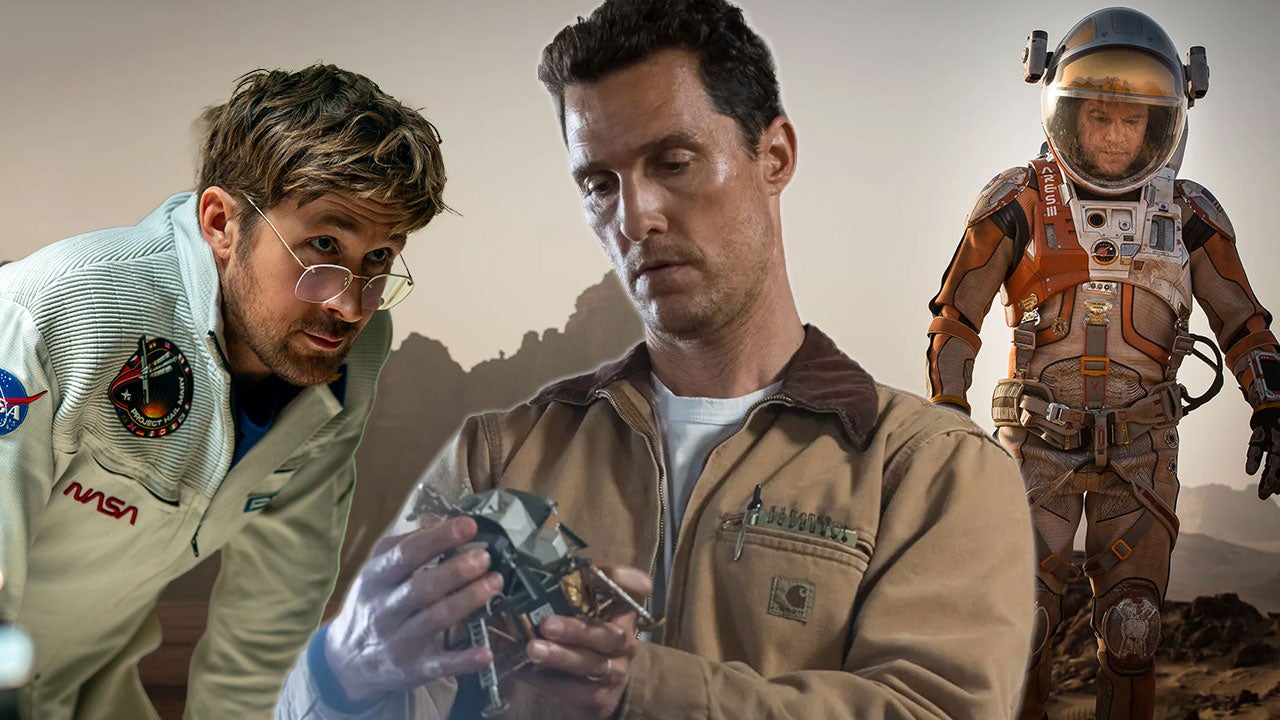
We can all agree on a few fundamental truths: Space is vast. Space is terrifying. Space is lonely. Out there, confronted with the fact that the universe is mostly made up of grand swathes of nothing, it’s only natural that a person (human or alien) would despair at their insignificance in the face of it all. We already have a long-established genre that deals with this type of cosmic crashout—space horror movies, shows, and games are alive and well, and we love them—but what about the alternative? What about the stories where, instead of succumbing to that feeling of insignificance, the characters decide to take a more hopeful angle on their situation? It sounds corny, and it is, but the best “hopecore” space movies declare that we still have a place in the universe, even if that place is teeny-tiny.
That’s exactly what Project Hail Mary, based on The Martian author Andy Weir’s hard sci-fi novel, is wrestling with. In the movie, not-so-heroic science teacher Ryland Grace (Ryan Gosling) is blasted into space on a last-ditch mission to save Earth’s sun by examining the environment of a far-off star. His crewmates died in transit, but Grace isn’t alone: Another extraterrestrial astronaut—an alien boulder-spider Grace nicknames Rocky (James Ortiz)—has made the trip from a different solar system experiencing the same problem as Earth. While the two learn to communicate and problem-solve as a pair, they develop the kind of charming interspecies friendship everyone hopes for when they imagine what it would be like to meet an alien. Their camaraderie under duress leads them inexorably towards an exhilarating, tearjerking finale that reminds them—and us—that survival only matters if we can do it together.
With this uplifting message, Project Hail Mary joins a small but ever-growing subgenre of hard sci-fi movies with the sense of fun and whimsy you’d expect from a Star Wars- or Guardians of the Galaxy-type gonzo space adventure. Like The Martian, based on Weir’s debut, Project Hail Mary has a similarly goofy “let’s science the s—t out of this” energy that would feel more at home in a movie where the main characters have ray guns and parade around on planets with killer plants and beautiful blue-haired alien women. Instead, these movies are grounded, and, for the most part, pretty sober and straightforward, choosing to champion the grunt work of equations, experiments, and physical toil over physics-defying heroics. That commitment to realism makes their ultimate message of hope in the face of near-certain annihilation all the more uplifting.
Interstellar is probably the ultimate hopecore hard sci-fi movie, committed as it is to providing its mind-boggling metaphysics with a solid foundation of practical science. When presented with familiar images of rockets, astronauts in not-so-futuristic spacesuits, and mathematically accurate black holes, your audience will believe that Matthew McConaughey did indeed use the fourth dimension to travel backwards through time and send his daughter a message via dust particles. And, ultimately, it’s the relationship between McConaughey’s Cooper and daughter Murph—that determination of a regretful father to cross time and space to see his daughter again—that gives Interstellar its thematic throughline. A movie like Interstellar needs that grounding force in order for its loftier, more emotional beats to work as potently as they do. Otherwise, it’s all just lights and noise. (Speaking of which, I’d be remiss not to mention 2001: A Space Odyssey, which, while not exactly hopecore, was certainly made with the knowledge that audiences will more easily digest a trippy third act if they had just watched two hours of astronauts doing pretty realistic-looking astronaut stuff first.)
Which brings us to an underappreciated but no less notable hopecore space movie: James Gray’s Ad Astra. Brad Pitt and Tommy Lee Jones are at their most mournful and teary-eyed here, playing a son and his father who are both searching the cosmos for alien life… and for the sense of hope that the possibility of said life would bring. It’s certainly not as fun as any of the previously mentioned films—it’s barely any fun at all—but Ad Astra has a similar agenda. One could argue, and I will, that the film is the most grounded of all these movies, even though most of the action takes place on the moon and in spaceships, because its ultimate punchline is that everything that matters in this universe is back on Earth, where it always was. When Pitt’s reluctant astronaut finally locates his father and discovers that he’s failed in his mission to find the aliens, he tells his dad: “We’re all we’ve got.” It’s an admission of defeat, but it’s also a victory. Now they—and the rest of humanity—can focus on what really matters.
Sure, maybe it’s facile to embrace films whose meaning, when presented with an entire universe of options, boils down to “Be nice to each other,” but it’s still a message we could stand to be reminded of once in a while. And, given how popular many of these movies are, it’s a message people are apparently hungry for, especially in times of uncertainty and hardship. There’s a reason these stories focus on such mundane relationships: the bonds between a father and a daughter, a father and a son, a science teacher and a charming alien with a 3D printer.
What do you do when confronted with the endless void of the universe? Find someone to confront it with you. It’s no more complicated than that.