
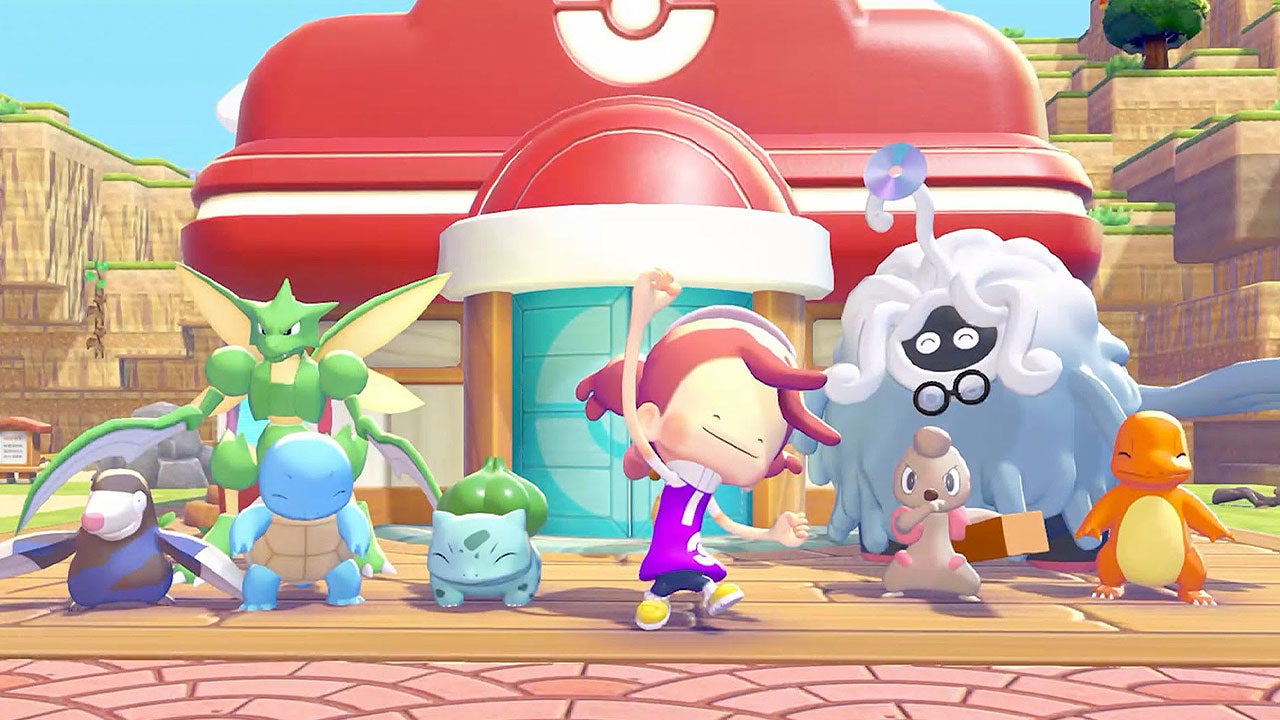
Given the recent love for Pokémon stuff that simply lets you watch them hang out in different environments (New Pokémon Snap, Detective Pikachu, Pokémon GO, etc), it's astonishing that it took this long for Pokémon Pokopia to emerge. It marries two ideas that probably should have been smashed together a long time ago: life sims and Pokémon. Koei Tecmo's Omega Force was the right studio to snatch the idea up, too, after its success working on Dragon Quest Builders 2 with Square Enix and its ongoing positive reputation for Dynasty Warriors x Nintendo crossovers. Given all this, I came into Pokémon Pokopia having built up skyscraper-high hopes, and I'm happy to say it exuberantly met me at the top.
In Pokopia, you play as a Ditto that has transformed into the roughly human shape of their former trainer, who is now missing. Ditto is released unexpectedly into a Kanto region that looks… quite different from what you might remember in other games. You start in the ruins of what you'll very quickly recognize as Fuchsia City, but drought-stricken and with buildings reduced to rubble. A friendly Tangrowth posing as a Pokémon professor is there to greet you, and together the two of you undertake a 40+ hour effort to restore the region to its former glory in hopes of attracting both people and Pokémon back home. This turns out to be a pretty compelling premise, both in the mystery you’ll slowly uncover about what happened to the world, as well as in how that recovery ties closely into your actual minute-to-minute tasks.
You'll start by rebuilding natural Pokémon habitats, such as patches of tall grass or flowers which will in turn attract new Pokémon to come live within them, but eventually construct whole buildings and furniture pieces as you build out a little community. As a Ditto, you have the ability to Transform into other Pokémon, allowing you to use their abilities to restore the land. For instance, a Squirtle will teach you Water Gun early on, which allows you to water the dry ground and bring back dead trees, bushes, grass, and flowers. From a Bulbasaur, Ditto learns Leafage, allowing them to raise up new tall grass from previously empty ground. Rock Smash breaks rocks, Cut chops up foliage, and so on. Much later, you'll be able to turn into a Lapras to Surf across water, and finally, a Dragonite will teach you to Fly (well, glide) through the air.
This is where a lot of Pokopia's personality shines, as it really goes all-in on reminding you that you are a Ditto, a blobby pink creature that can shapeshift into anything. Ditto gains a shell and Squirtle tail when it uses Water Gun and green vine arms for Leafage. It can suck items into its inventory in bulk by slurping them up into its mouth, Kirby-style, effectively absorbing them until it needs to spit one back out again. If you fall from a great height, never fear: you're a Ditto! You just blop into a pink goo for a moment, then reform into your human shape. One of the idle animations is just Ditto collapsing into its pink gooey self again and falling asleep. There is so much attention to detail in Pokopia's animations and marriage of mechanics and character, and all these little touches combined to keep me locked into the universe and fantasy of being a Ditto dressed as a person, glooping about this ruined world. I didn't really care about Ditto before, but after Pokopia? I love this weirdo!
That level of detail extends to your Pokémon friends, all of whom are given colorful personalities and plenty of things to do once they settle into their new homes. You can give them gifts to raise their comfort levels and affection for Ditto, which will often result in them giving you gifts themselves. They'll invite you to play games, such as Hide and Seek (a game that effectively turns into Prop Hunt once Ditto gets the "Camouflage" ability), or give you little quizzes on Pokémon facts. Pokémon will just have fun on their own, too – you can watch them react to items you leave out in the world, play tag with one another, or even make friends with their neighbors.
Each Pokémon also has different abilities that dictate how they interact with the world. You'll frequently want to enlist Pokémon like Scyther to chop wood for you or Piplup to wash away sewage, which is a mostly-great way to highlight the strengths of Pokémon that don't normally get the spotlight. I say "mostly" because I was a bit irritated later on by how much trekking back and forth between areas I had to do to figure out which Pokémon I left all my iron ore with or who was converting my clay into bricks, but largely it was a positive that almost every Pokémon had a genuinely cool purpose. Between all that and the presence of a Pokedex (that was significantly larger than I expected), I found myself very motivated to design increasingly complex habitats to attract rarer and rarer monsters in hopes of filling out every last entry.
One other small detail I wanted to call out was how good "pathing" in Pokopia is. I've played tons of games that involve escort quests where you need to get someone to follow your character somewhere, but they constantly get stuck on the terrain. Pokopia's pathing is great. If Ditto can find a path somewhere, whoever is following them almost always can too without issue. This even extends to mechanisms such as elevators and sky lifts, the latter of which actually show the Pokémon following you (cleverly, up to five at a time) climbing aboard subsequent lifts and riding across a gap with you. You'll be asking a lot of monsters to follow you around in Pokopia, so it was nice to be consistently impressed with how well this mechanic just… worked.
As more and more Pokémon return to the world, they'll start to want more than just a patch of grass to lounge in. They've got needs! On a simple stroll through the area, Charmander stops me to tell me he thinks it's too wet around here, and wants a drier, ideally fiery spot to hang. I'm off to build him a campfire, only to be accosted by Squirtle, who would like to move someplace close to a water source. Bulbasaur shows up to tell me he thinks his grass patch is too dim, and could stand to be lit up. I see a spot that would benefit from a table and chair, so I get distracted gathering materials for that, and then Drifloon shows up wanting a doll for some reason, and oh that empty spot right there would be perfect for a small hut, let me just make some more bricks and… wait, is that block over there glowing? Pokopia is a game of little chores, and every one of those chores provides a satisfactory dopamine rush as you watch a new building appear or a patch of previously barren landscape fill out with cute creatures doing adorable activities. The loop was so engrossing that I did not once mind the absence of any combat – something present in Dragon Quest Builders but (for pretty obvious story reasons) is not a part of Pokopia. It doesn't need it.
One minor issue that tripped me up, however, was the storage in Pokopia. Ditto has an inventory that can be expanded over time, and you can also construct storage boxes both small and large to put more items in. This works for a while, but because there's no unified storage, by the end of Pokopia I was having trouble remembering what box in what region I had put that certain item I now needed. Frequently when a quest called for something specific I had to fast travel between multiple regions, through multiple loading screens, then look through multiple boxes just to find it. I understand wanting to limit storage during Pokopia's story mode so that you don't haul enormous quantities of junk from place to place and are instead forced to use each new environment to solve your problems. But the post-game really, really needed some sort of unified, interconnected storage box between all the regions into which I can dump 20 stacks of 99 sand.
As Pokopia progresses, the dozens of little chores slowly evolve into bigger, more grandiose projects. There are four main story regions to explore and reconstruct, each with different habitats, monsters, and themes to build around. Pokopia's actual construction mechanics will be familiar to anyone who's played these cube-based building games before. You break up the blocks of the environment, collect them in your inventory, craft other blocks out of gathered resources, then stack cubes, make structures, and fill them with decorative items. I unfortunately suspect that savvier builders than myself may not be thrilled by the building controls; I frequently found it difficult to position blocks exactly where I wanted them due to limitations on where and how I could move them, as well as a troublesome camera when working in smaller spaces. Other games (Animal Crossing: New Horizons!) have solved the problem of precise placement, and I wish Pokopia had followed their lead here.
The story regions of Pokopia have loads of ruined building foundations and other "suggestions" of spaces that you could start from, or you can tear it all down and begin anew. It's a healthy, enjoyable mix of freedom and guidance that satisfied both the desire to make anything I wanted and the need, at times, to just get a dang house up and move on. As someone who's not great at making aesthetically pleasing spaces, I was grateful for the presence of building "kits" that, when filled with resources and assigned some worker Pokémon, would become pre-made structures that actually looked nice, allowing me to skip most large-scale manual construction if I chose to. And then there's Palette Town, a bonus non-story region explicitly set aside for players to build from scratch. It's so massive I have no idea how to even begin turning it into a proper metropolis. There's enough space to build huge, absurd sculptures like folks have been doing in Minecraft for years, or get together with friends and construct an entire Pokémon-filled world with multiple towns. I'm stoked to see what the real artists get up to in there.
One of the most surprising and wonderful elements is the story. So much of my delight in Pokopia is in wandering through this ruined version of Kanto, collecting notes and logs explaining what happened to the world and stumbling into locations that will be recognizable to longtime Pokémon fans like me. Walking into a ruin and feeling the gut-punch as I realized where I was and what happened here really, really hit, and Pokopia's capitalization on that feeling is pristine. (I'd be remiss not to mention the excellent soundtrack as well, which sprinkles in familiar melodies in exactly the right dose, then twists those tunes around in a reminder that the world is not what it once was.) Fans familiar with the original games or their remakes might get more out of this than those who haven't played them – but I think that the environmental storytelling, the slow drip of clues, and the contrast between the tragic fate of this world and Pokopia's cheery tone should be able to hook even those with a less intimate knowledge of the setting.
