There's a myriad of reasons why we're so locked into The Pitt right now — the gripping stories, the authentic cast of characters, the glimpse of how ER doctors can make life or death split-second decisions — but according to director of photography Johanna Coelho, it's also because of the way each scene is carefully shot, dressed, and lit.
In a new interview with SlashFilm, Coelho opened up about how the deceptively ordinary set dressing and clever camera work keeps us immersed in the fictional Pittsburgh Trauma Medical Center, suggesting that at its heart, the medical drama is essentially "about emotions" — "the emotions that the characters are experiencing during their shift."
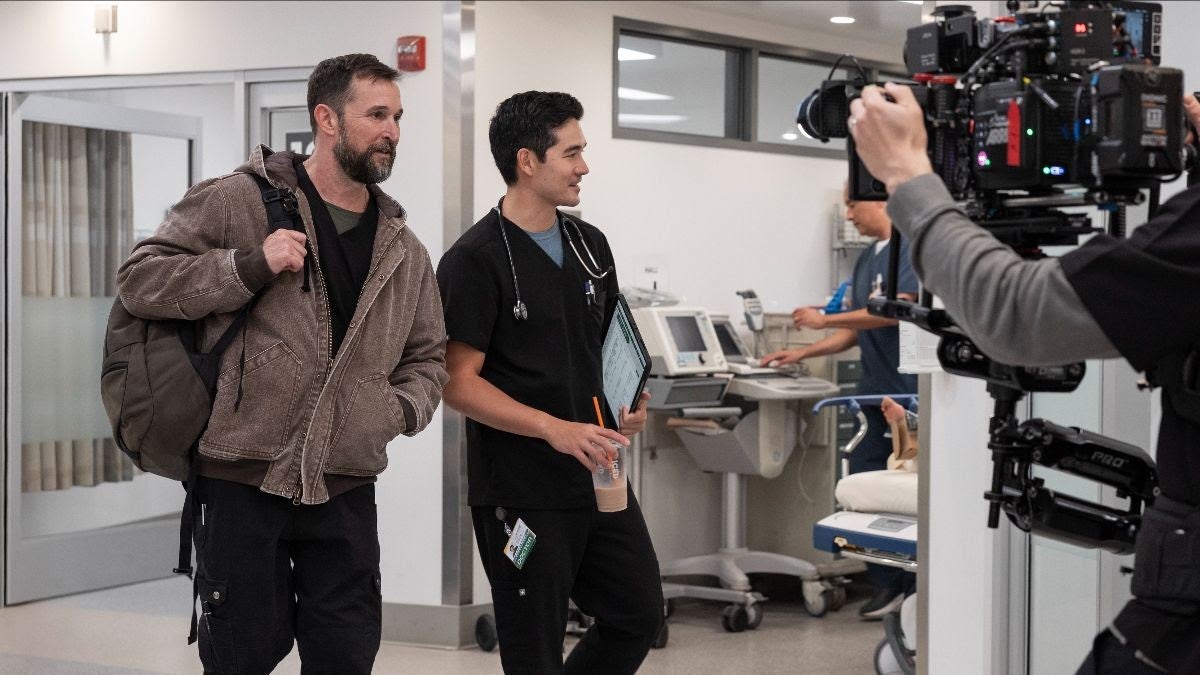
"We're trying to be as invisible as we can, as natural as we can, but there is a lot going on in every single shot," Coelho said. There are two cameras running almost at the same time "all the time," and this is why the lighting is so important; a lot of work goes into making PTMC look and feel authentic to the audience.
"We tested so many shades of white, I think around 50 or more, to find the right white that looks good again[st] every single skin tone, because once the light's bouncing [off] it, that really reflects the color of the wall on people. So that was all very important. I love that people don't really see all these elements and don't imagine them. We're trying to be as invisible as we can, as natural as we can, but there is a lot going on in every single shot."
Writer, executive producer, and Dr Michael "Robby" Robinavitch himself, Noah Wyle, further expanded on this in a separate interview with GQ.
"Shooting it with almost exclusively 50-millimeter or 65-millimeter lenses, which is the most comparable to the human eye — and only shooting from the point of view of a human being that's present in this space," Wyle said. "There are no cameras on gurney wheels going in the hallway. There's no cameras on the ceiling looking down from a God point of view. You are limited to the perspective of a participant. You can look away, but you can't leave, and it becomes an endurance test for you to stay on your feet as long as we're on our feet.
"Real time has an aggregate sense of tension that you don't get in any other form of storytelling. What happened before is happening now, and these two things are going to add up to the next thing. And if we throw more ingredients into this cooker and keep ratcheting it up, it's going to pop."
Coelho agreed, saying in her interview: "So sometimes we'll have a longer lens, like a 75 millimeter, which makes the world disappear even more around them, which sometimes helps emphasize that moment of isolation or hyper-focus on the person they're talking to and the world is disappearing around them. So little elements like that help us give a signification throughout the framing and the shots."
Our thoughts on The Pitt season 2 episode 15 are now live. We thought the finale "is dramatic and ominous when it needs to be, but it also manages to frequently be heartfelt and humorous. It’s a well-rounded endcap to a largely successful season of television."
Image credit: Warrick Page/Max.
Vikki Blake is a reporter for IGN, as well as a critic, columnist, and consultant with 15+ years experience working with some of the world's biggest gaming sites and publications. She's also a Guardian, Spartan, Silent Hillian, Legend, and perpetually High Chaos. Find her at BlueSky.