
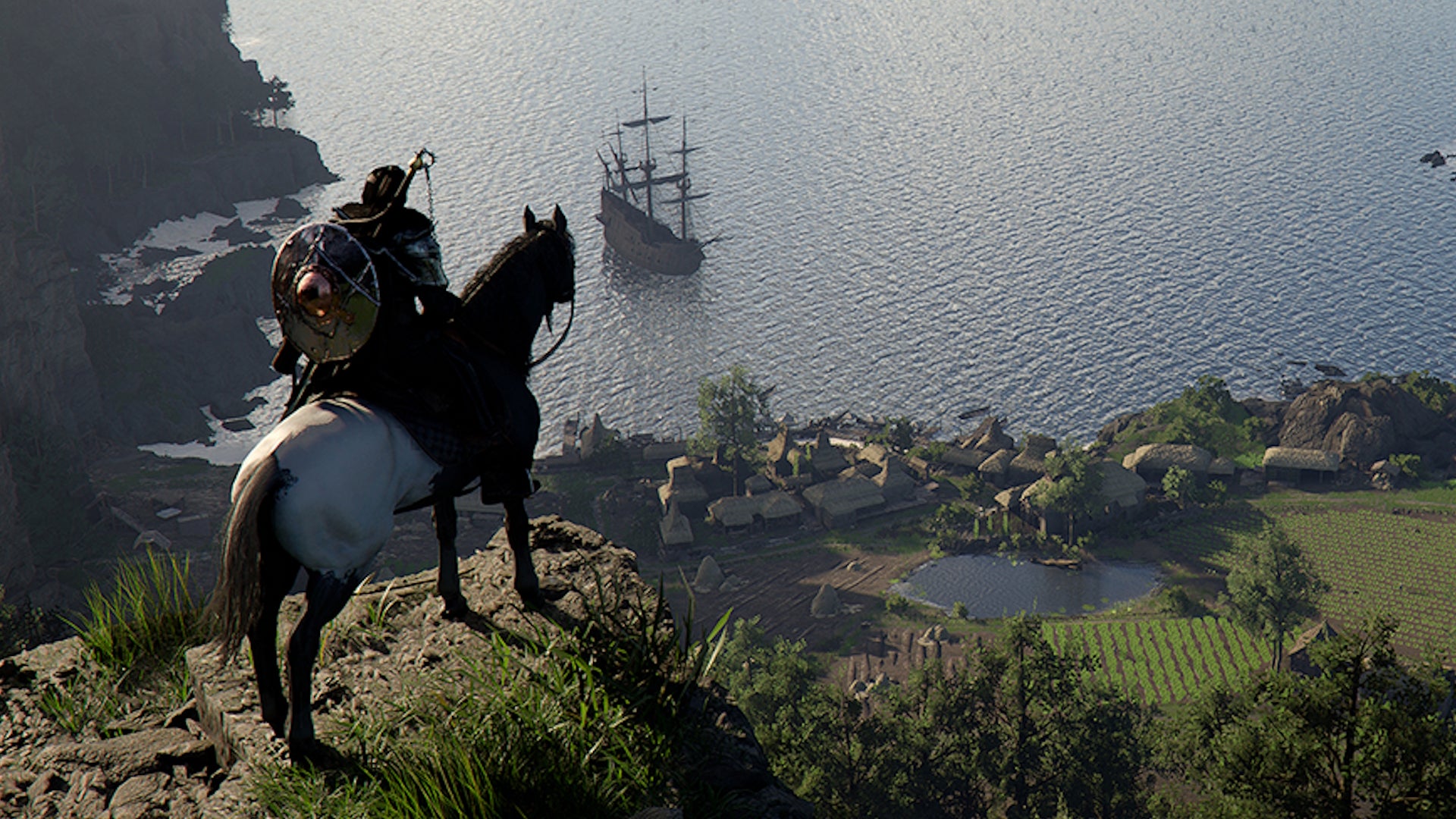
Scrambling up to a platform high above Trembling Gorge cost me time, stamina, and – when I mistimed my magical grappling hook – a big chunk of health. But it was worth it for the incredible panorama view of Hernand's eastern undulations.
Towards the southern coast, a stout fortress lurks behind a meandering line of spikes – a stone spire stabs skywards to the right, and from it a track tumbles down the hillside, spilling between gaps in the rock. North is a circular city squatting on a high plain, and beyond, faraway red hills, nearly flat-topped like mesas, an impossible spindly structure jutting from one peak.
Crimson Desert's world looks its best when it stretches beneath you, your eyes following natural paths between three, four, five waypoints without ever consulting your map. What I've found at those waypoints has often been limp quests – something we criticised in our review – or empty streets, but developer Pearl Abyss has done a few things especially well to encourage exploration from on high, and I still feel compelled to conquer every peak.
Its landscape is vivid and, to use an unsexy term, legible. Its spires shine against the blue sky, some glowing with an other-worldly light that hues from green to yellow. Changes of colour mark new zones: the shock of snow or, to the north of the starting area, Hernand, a sudden wall of red leaves. Its long draw distances, at least on a decent PC, highlight distant, beckoning landmarks.
When night floods the horizon, braziers and bonfires flicker in every village and camp, drawing your eye. The Blinding Flash ability – activated by pressing the two shoulder buttons – reflects light from my sword and every unlockable fast travel point twinkles back, helping me find places obscured by dense tree canopies.
From every high spot you can glance in any direction and instantly know where to head. I like that your minimap doesn't highlight the route to markers: you should plan your journey rather than stare at the corner of your screen. I usually open my map before I set off, just to get the lay of the land, and then rely on roads, compass points and landmarks to guide me.
It helps that traversal is its own form of fun. The more skill points I've dumped into stamina, the more I've enjoyed flinging myself off high perches, alternating between gliding and soaring in winged form, testing how far I can travel before I splat. If you choose the right upgrades – double jump, force palm, aerial maneuver, aerial swing – you can grapple and leap over virtually any obstacle. Or, simply yank a tree down to create a makeshift giant slingshot.
The landscape unfurls in layers and when you reach your destination you'll often discover parts of the map previously hidden from view. From Trembling Gorge I flew south and vaulted the spikes of Thornbriar Fortress – then, I cut west through hails of arrows from a bandit group occupying the next fort over, and up the path to the Spire of Insight. When I'd ticked that off I looked West again and saw, for the first time, the fishing town of Vellua lying far, far below me and a ruined ship a way offshore.
The same happened at the Spire of the Stars in the map's snowy west. I'd ignored its call for about 15 hours but when the main quest took me near, I couldn't resist. I slogged over, down into a valley and up a cliff too steep for my horse, the corners of my screen clouding with ice. When I reached its base, the stone domes and symmetrical gardens of the Scholastone Institute slid into view. I hadn't known it was there, but now it's my favorite location in the game so far, as if somebody slammed Roman ruins into the mountainside and wedged colourful planters in every available crevice.
I just wish these locations felt more alive, or at least gave me more to do.
Vellua's highlight was a man selling trout. Hundreds of soldiers protected Thornbriar Fortress and I couldn't interact with a single one, so it felt like a wasted journey: it's one of many locations that exists solely as a backdrop for the main quest.
Scholastone is another. The door to the Spire of the Stars was locked when I arrived. Diving down to the institute itself, I found a tedious quest to interview several NPCs about a missing book. A glowing puzzle of electrified pillars, clearly marked on the map, distracted me – but nothing happened when I solved it. So I slunk away, only to return two hours later for the main quest and complete the same puzzle, this time triggering a mini boss fight. Ten minutes later, the tower was magically unlocked.
Overtaking the languid main quest feels too easy. It's as if the world is encouraging me to explore, but penalizing me for doing it too early – if it's not gating puzzles behind the story, it's blocking my travels to faraway parts of the map with frenzied groups of patrolling guards who will slay me on site.
Crimson Desert has, just about, fed me enough morsels to hold my interest. A hidden cave halfway up a nearby waterfall west of Vellua; a magical forest of fae children that I can only unlock by stealing a relic from the top of a giant walking tree. Nothing has wowed me, and I've found the writing to be universally flat – but the satisfaction of planning my journeys, the verticality of its landscape and the sheer number of points on the horizon means that, for now, I'll keep climbing.
If you’re jumping into Crimson Desert’s huge open world, we recommend you take a look at our guide to Things to Do First in Crimson Desert, plus Things Crimson Desert Doesn’t Tell You (we’ve got 28 and counting!). We’ve also got a guide to the Best Early Weapons we recommend picking up, the Best Skills to Get First (including a handy explainer of the skills system), and 34 Essential Tips and Tricks to help you succeed in Pywel.
